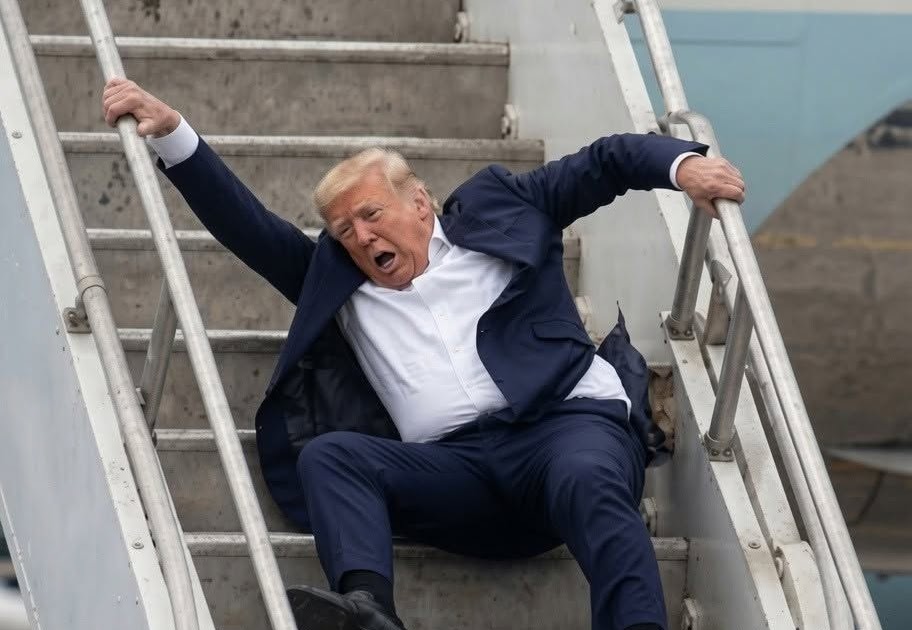
🚨 “Trump FALLS AGAIN!” — What Viral Headlines Reveal About Modern Media, Political Health, and Online Attention
Few things spread across social media faster than a dramatic headline involving a major political figure.
A celebrity health scare.
A shocking medical revelation.
An unexpected public incident.
And when the person involved is one of the most recognizable political figures in the world, the internet’s reaction can be immediate and intense.
Recently, headlines and social media posts with phrases like “Trump FALLS AGAIN!” and “White House Doctor Breaks Silence” have circulated online, generating millions of views, comments, shares, and heated debates.
But beyond the headline itself lies a larger story—one about modern media, public curiosity, political transparency, and the way information travels in the digital age.
Why do these stories spread so quickly?
Why are health rumors surrounding public figures so persistent?
And what can these viral moments teach us about how people consume information in 2026?
Let’s take a closer look.
The Power of a Single Headline
Modern headlines are designed to compete for attention.
Every day, people scroll past thousands of pieces of content:
News articles
Social media posts
Videos
Podcasts
Advertisements
Breaking alerts
In that environment, attention becomes a valuable resource.
A headline that says:
“President Attends Medical Appointment”
is unlikely to generate the same response as:
“White House Doctor Breaks Silence After Shocking Health Incident”
Both may refer to the same topic.
But one is informational.
The other is emotional.
And emotion drives engagement.
That reality has transformed the online information ecosystem.
Why Political Health Is Always News
The health of political leaders has always attracted public attention.
This isn’t unique to Donald Trump.
Throughout history, questions about the physical and mental condition of presidents, prime ministers, kings, and other leaders have generated enormous interest.
The reason is straightforward:
Leadership decisions affect millions of people.
When a leader’s health becomes a topic of discussion, citizens naturally want answers.
Questions arise quickly:
Is the leader capable of performing their duties?
Is important information being withheld?
Are official statements accurate?
Should the public know more?
These questions are not new.
What has changed is the speed at which speculation spreads.
The Social Media Amplification Effect
In previous decades, health rumors often traveled slowly.
Today they can circle the globe in minutes.
A short video clip.
A photograph.
An unusual facial expression.
A stumble.
A pause during a speech.
Any of these moments can trigger widespread discussion.
Once social media users begin sharing theories, algorithms often amplify the content because controversy and uncertainty generate engagement.
The result is a cycle:
An event occurs.
Speculation begins.
Users share interpretations.
Media outlets report on reactions.
More people join the discussion.
The story becomes larger than the original event.
Sometimes the speculation proves accurate.
Sometimes it doesn’t.
But by then, millions of people have already seen the claim.
The Challenge of Verification
One of the biggest challenges in modern media is distinguishing between verified information and assumptions.
Many viral claims begin with a real event.
Then additional details are added.
Then interpretations emerge.
Eventually, opinions become confused with facts.
This creates a difficult environment for readers.
The responsibility increasingly falls on individuals to evaluate sources carefully and separate evidence from speculation.
Presidential Health and Public Transparency
The issue of presidential health transparency remains a subject of debate.
Some argue that voters deserve detailed medical information about national leaders.
Others believe elected officials retain a right to medical privacy.
Finding the balance between those positions has never been simple.
Every administration faces questions about disclosure:
How much information should be released?
Which medical records should remain private?
How frequently should updates be provided?
Who verifies official reports?
These questions often become especially prominent when leaders reach advanced ages.
As populations age worldwide, these discussions are likely to become even more common.
Why Health Rumors Never Truly Disappear
Rumors about prominent political figures often persist regardless of official statements.
This happens for several reasons.
Confirmation Bias
People naturally seek information that supports their existing beliefs.
If someone already views a politician negatively, they may be more likely to believe claims about decline or illness.
Likewise, supporters may dismiss legitimate concerns too quickly.
Information Gaps
When complete information is unavailable, people fill the gaps themselves.
The less certainty exists, the more speculation tends to grow.
Emotional Investment
Political figures inspire strong emotional reactions.
Supporters and critics alike often interpret events through personal and ideological lenses.
As a result, even routine events can become major controversies.
The Role of Official Medical Reports
Official physician reports are intended to provide factual information.
However, they rarely eliminate debate entirely.
Supporters view them as reassurance.
Critics may question their completeness.
Media organizations analyze them.
Medical experts offer interpretations.
Political opponents raise additional questions.
The conversation continues.
This pattern has repeated across multiple administrations and political parties.
No official report exists in a vacuum.
How Viral Narratives Form
One fascinating aspect of online culture is how quickly narratives emerge.
A narrative is not necessarily a fact.
It is a framework people use to interpret information.
For example:
A stumble becomes evidence of decline.
A medical visit becomes evidence of crisis.
A routine checkup becomes evidence of secrecy.
Once a narrative takes hold, every new piece of information tends to be interpreted through that lens.
That doesn’t mean the narrative is true or false.
It means human beings naturally organize information into stories.
And stories are powerful.
Media Literacy in the Digital Era
The modern information environment demands a new skill set.
Media literacy is no longer optional.
It is essential.
Readers benefit from asking questions such as:
What is the original source?
Is the claim verified?
Are multiple outlets reporting the same facts?
What evidence supports the conclusion?
Is the headline designed to inform or provoke?
These habits help people navigate an increasingly complex media landscape.
The Economics of Attention
Behind many sensational headlines lies a simple reality:
Attention has value.
Clicks generate advertising revenue.
Shares increase visibility.
Engagement boosts reach.
As a result, content creators often face incentives to maximize emotional reactions.
Fear.
Anger.
Shock.
Curiosity.
These emotions drive interaction.
Understanding this dynamic helps explain why dramatic headlines continue to dominate online conversations.
Looking Beyond the Headlines
Ultimately, headlines are only the beginning of a story.
The most important information usually appears deeper in the reporting.
Context matters.
Evidence matters.
Verification matters.
A dramatic title may capture attention, but careful analysis reveals what actually happened.
That principle applies not only to politics but to nearly every topic in modern media.
Final Thoughts
The next time a headline declares a shocking development involving a major public figure, it is worth pausing before accepting the story at face value.
The digital world rewards speed.
Truth often requires patience.
Whether the subject is politics, health, business, entertainment, or international affairs, the most reliable understanding usually comes from examining evidence rather than reacting to the loudest headline.
In an age where information travels faster than ever, critical thinking remains one of the most valuable tools any reader can possess.
And sometimes, the real story isn’t the headline itself.
It’s the reason the headline was written that way in the first place.