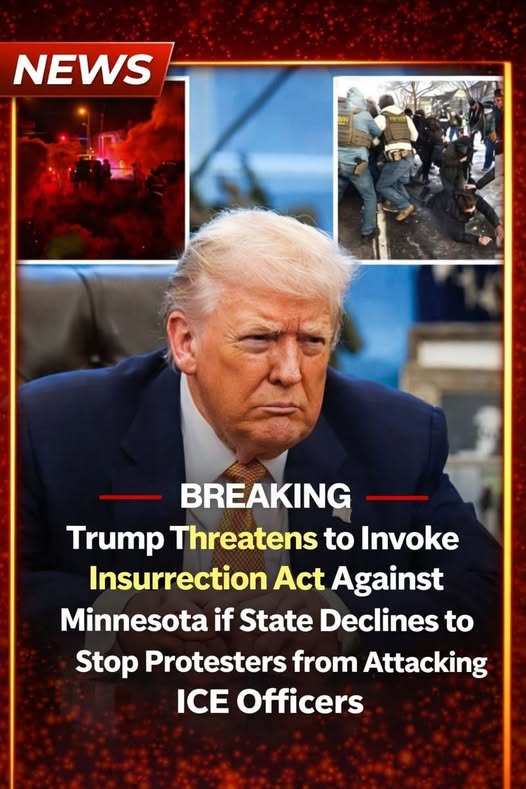
In a mid-January 2026 developments that has sent shockwaves through the American landscape, Minnesota has become the epicenter of a constitutional crisis. Political tensions have escalated into a historic confrontation between state and federal power, punctuated by President Donald Trump’s public threat to invoke the Insurrection Act of 1807. The rarely utilized federal law—which allows for the domestic deployment of the U.S. military—is being considered in response to widespread civil unrest and protests sparked by an unprecedented federal immigration enforcement operation. What began as an agency-level surge has transformed into a flashpoint of violence, litigation, and a looming test of presidential authority that may redefine the limits of state sovereignty.
1. The Federal Immigration Enforcement Surge
In the opening days of 2026, the Department of Homeland Security (DHS) and Immigration and Customs Enforcement (ICE) launched a massive operation in the Minneapolis–Saint Paul metropolitan area. Described by officials as one of the largest ICE mobilizations in recent history, the surge saw thousands of federal agents flood neighborhoods, public spaces, and federal installations.
While federal leadership maintains the operation is a lawful and necessary effort to enforce immigration statutes and detain suspected violators, local critics and residents have characterized the presence as an aggressive and disruptive “occupation” of their communities.
2. Fatal Shooting of Renee Nicole Good
The situation reached a breaking point on January 7, 2026, when 37-year-old Minneapolis resident Renee Nicole Good was fatally shot by an ICE officer during an enforcement action. The revelation that Good was a U.S. citizen ignited a firestorm of national outrage.
Federal statements claim the officer discharged his weapon because Good’s vehicle allegedly attempted to strike him or other personnel. However, community members and local authorities have challenged this narrative, accusing federal agents of employing excessive force. Tensions were further exacerbated days later when another ICE-involved shooting in north Minneapolis left a Venezuelan man wounded.
These incidents have served as a catalyst for daily confrontations between residents and law enforcement, with some clashes resulting in the use of tear gas, flash-bang devices, and multiple arrests.
3. State and Local Defiance
Minnesota Governor Tim Walz and Minneapolis Mayor Jacob Frey have emerged as the primary political opposition to the federal presence. Both leaders have issued public condemnations of the federal tactics, accusing agents of inciting chaos and violating civil liberties.
In a move to assert state oversight, the Minnesota Bureau of Criminal Apprehension (BCA) has launched an independent investigation into the January 7 shooting. The FBI has also been deployed to the Twin Cities to oversee evidence collection and monitor the escalating violence.
4. Legal Warfare: Minnesota v. The Federal Government
The conflict has now moved into the courtroom. The State of Minnesota, along with the cities of Minneapolis and St. Paul, has filed a federal lawsuit seeking an immediate injunction against the immigration operation. The plaintiffs argue that the federal presence violates First Amendment rights and has created fundamentally unsafe conditions for the public. The suit marks a significant legal escalation, accusing DHS and ICE of unconstitutional overreach.
5. The Insurrection Act Threat
On January 15, 2026, President Trump intensified the standoff by signaling his intent to invoke the Insurrection Act if Minnesota authorities “fail to restore order.” This 19th-century law permits the President to bypass state consent to deploy active-duty military or federalize National Guard troops to suppress “domestic violence” or the “obstruction of federal law.”
The White House has categorized certain protest activities as “insurrectionist,” arguing that local interference is preventing federal agents from fulfilling their duties. The move to put boots on American streets would represent an extraordinary use of executive power, a step rarely seen in modern domestic politics.
[Image showing the legal hierarchy of the Insurrection Act and the requirements for presidential invocation]
6. National Political Fallout
The President’s rhetoric has divided Washington along familiar but deepening lines:
-
Democratic Opposition: Lawmakers have characterized the threat as a dangerous abuse of military authority against peaceful civil protest.
-
Republican Caution: While some support the President’s “law and order” stance, prominent Republicans have cautioned against the use of the military, urging a return to local law enforcement reliance.
-
Legal Perspective: Constitutional scholars warn that invoking the Act over the explicit objections of a Governor would face immediate and aggressive challenges in federal court.
On January 16, the White House appeared to offer a slight de-escalation, with the President stating there was “no reason right now” to deploy the military, though he insisted the option remains “on the table.”
7. Disruption of Daily Life
The ongoing crisis has effectively paralyzed the Twin Cities. Several school districts have reverted to remote learning due to safety concerns, while local businesses report a climate of profound anxiety. Community leaders warn that the aggressive federal presence is permanently eroding the trust between law enforcement and the populations they serve.
8. An Unresolved Constitutional Standoff
The situation remains a volatile legal and political quagmire. With independent use-of-force investigations, state-led lawsuits, and new Justice Department inquiries into whether state officials are “impeding” federal law, the resolution is nowhere in sight.
As Minneapolis remains under the national microscope, the core question remains: will the federal judiciary intervene, or will the streets of Minnesota become the site of a historic military deployment?
Summary: A Crossroads for Constitutional Authority
The events that paralyzed Minnesota in January 2026—beginning with an unprecedented surge in federal immigration enforcement and escalating through fatal shootings, mass civil unrest, and a presidential threat to deploy the military—represent more than a local crisis. They reflect a volatile convergence of the most critical tensions in modern American governance.
At the heart of this standoff are four defining questions that will likely resonate for years:
-
The Reach of Federal Enforcement: The strategies and aggressive methods employed by federal immigration agencies have come under intense scrutiny, raising questions about the human and social costs of large-scale operations.
-
The Boundaries of State Sovereignty: The friction between Minnesota’s leadership and the White House has highlighted the murky legal limits of state and local authority when confronted by federal mandates.
-
The Scope of Executive Power: President Trump’s signaling of the Insurrection Act has reignited a fierce debate over the definition and limits of a president’s power to deploy domestic military force.
-
The Role of Public Dissent: The scale of the protests has forced a national conversation on the line between protected civil dissent and the maintenance of federal order.
As legal battles move through the courts and community investigations continue, the fallout from this January flashpoint will continue to dictate the political and legal landscape for months to come.