Brian Entin Revealed A Woman Connected To Nancy Guthrie’s Kidnapper Was Just Arrested In Arizona
June 8th, 2026, Tucson, Arizona.
The Pima County Sheriff’s Department did something they had not done in weeks.
They went public with a name.
Not the name of Nancy Guthrie’s abductor, not the name that everybody has been waiting for since February 1st, but a name that when Brian Anton first saw the alert come across, made him stop.
Made him read it twice.
Because on the surface, it looked like a separate case.
It was described as a separate case.
It was officially called a separate case.
But the geography of it, the specific distance, the specific type of crime, the specific timeline, and the very specific criminal history of the woman being sought, opened up a set of questions that Brian Anton was not willing to leave unanswered.
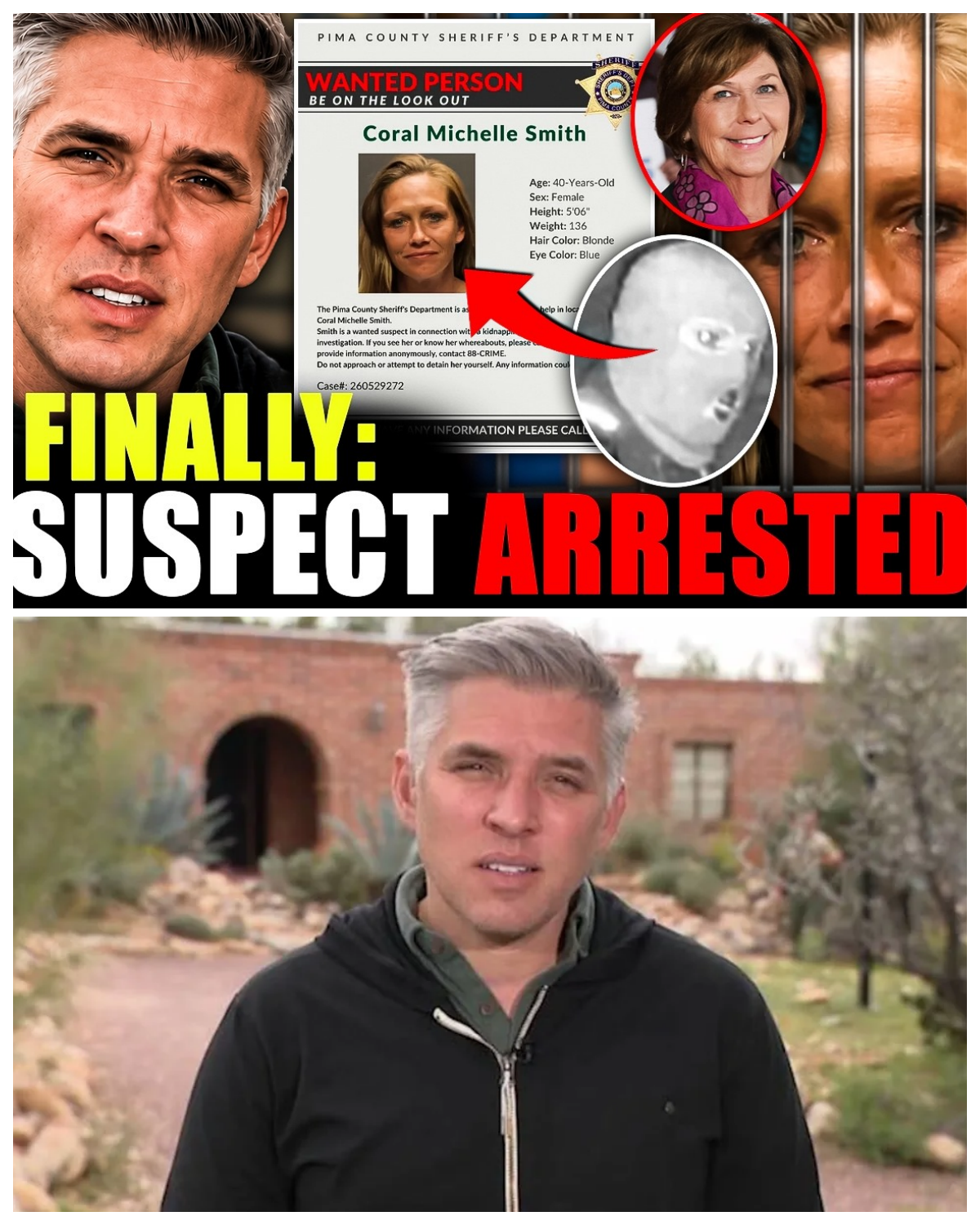
Her name is Coral Michelle Smith.
She is 40 years old.
She was being sought by the Pima County Sheriff’s Department on a warrant for kidnapping and aggravated assault with a deadly weapon.
And she had been operating, allegedly committing violent crimes, less than 7 miles from the home where Nancy Guthrie was taken.
7 miles.
Now, stay with me, because what happened over the next 8 days from the moment the bolo alert went out on June 7th to the moment Smith was arrested on June 15th to the moment the full details of her alleged crime became clear to the moment Brian Anton weighed in on what this all means inside an investigation that has been sitting in the shadows for months, is a story that pulls on every thread this case has been building since the very beginning.
And when you put all of those threads together in the right order, what you see is not a coincidence.
What you see is a neighborhood, a specific geographic zone in Tucson, Arizona, the Catalina Foothills area, the corridor running through River Road and La Cholla Boulevard, that in 2026 has become the center of something that law enforcement is not fully explaining to the public.
And Brian Anton knows it.
Let’s go all the way through this, every detail, every layer, starting from the beginning of this specific story.
On May 29th, 2026, 4 months after Nancy Guthrie was taken, an incident occurred at the intersection of River Road and La Cholla Boulevard in Tucson, Arizona.
That intersection is approximately 6.
8 miles from the Catalina Foothills home where Nancy Guthrie was abducted.
A 57-year-old woman named Rustin Lee Dodd went to a residence on North La Cholla Boulevard, a residence associated with Coral Michelle Smith.
What happened inside that residence, according to investigators, was violent.
Dodd was allegedly assaulted, and then, this is the element that triggered the kidnapping charge, she was allegedly prevented from leaving, held against her will in a residence less than 7 miles from where another woman, 4 months
Earlier, had been dragged from her own home by a masked figure carrying a backpack.
Dodd left the residence after the incident.
She didn’t go to a hospital immediately.
She went to a friend’s house.
She was injured.
She stayed there for several days, injured, not seeking treatment.
And then on May 29th, she became unresponsive.
She was rushed to a hospital, and on June 1st, 2026, just 5 days before the sheriff issued the bolo alert on Coral Michelle Smith, Rustin Lee Dodd died from her injuries.
Let that land.
The victim died.
This is not an assault case anymore.
This is not a kidnapping and assault case anymore.
This is a case where a woman is dead.
A woman who, according to investigators, was assaulted and held against her will in a Tucson residence in late May.
And the suspect, Coral Michelle Smith, was on the run for over a week while the Sheriff’s Department was processing the case and the coroner was determining cause of death.
Smith was loose in the same geographic zone that has been the center of the most high-profile kidnapping investigation in the country.
The warrant went out on June 7th.
The bolo, be on the lookout, went public on June 8th.
And the Pima County Sheriff’s spokesperson, Deputy Manuel Ruiz, confirmed it publicly.
Smith is wanted for kidnapping and assault with a deadly weapon.
The incident occurred less than 7 miles from Nancy Guthrie’s home.
And then, almost immediately, before the ink was dry on the bolo, the Sheriff’s Office added a line that they clearly understood the public would need to hear.
There is no indication that these two cases are connected.
All caps.
No indication.
And that is exactly the moment Brian Entin’s instincts kicked in.
Because when law enforcement preemptively distances a new case from the most high-profile open investigation in their jurisdiction, when they issue a disclaimer before anyone has even asked the question, it tells you something.
It tells you the question is obvious.
It tells you the proximity is too close to ignore.
It tells you that even the people issuing the disclaimer know that every person reading that BOLO alert is going to ask the exact same thing.
Is this connected?
So, let’s ask it properly, not recklessly, not with manufactured connection where none exist, but properly, the way Brian Entin asked it, by looking at the full picture of who Coral Michelle Smith is, what her criminal history shows, what the geographic picture of these two cases
Looks like when you map them against each other, and what the broader pattern of activity in the Catalina Foothills area in the weeks and months surrounding Nancy Guthrie’s disappearance actually reveals.
Coral Michelle Smith is 40 years old.
She is 5 feet 6 inches tall, approximately 136 pounds, blonde hair, blue eyes.
She has a smiley face and heart tattoo on her right ankle, a rose with flames on her right foot, and the phrase love, life, family tattooed on her left leg.
That last tattoo, love, life, family, on the leg of a woman accused of holding another woman captive in her residence, preventing her from leaving, assaulting her with enough force that she died 5 days later, carries a weight that is hard to put into words.
But, it is her criminal history that is most significant here.
Court records show that this is not Smith’s first encounter with kidnapping charges.
In 2020, she faced a kidnapping charge in Arizona.
That 2020 kidnapping charge was later dismissed, but in the same case, she was convicted of residential robbery.
Residential robbery, breaking into someone’s home or using a residence as the setting for a violent crime was something Coral Michelle Smith had done before.
She had been through the criminal justice system in Arizona before.
She had beaten a kidnapping charge once before, and 6 years later she was being sought for another kidnapping, one that this time ended in a victim’s death.
Less than 7 miles from the home of an 84-year-old woman who was dragged off her porch in the early hours of a February morning by someone who has never been identified.
The sheriff’s office said the cases are not connected.
Let’s be precise about what that statement means and what it does not mean.
It means that investigators have not found any direct evidentiary link between Coral Michelle Smith and the abduction of Nancy Guthrie.
It does not mean that Smith’s presence in that geographic zone is irrelevant to the broader picture of criminal activity in the Catalina Foothills.
It does not mean that the pattern of violent crime in that specific corridor is not something investigators should be examining as context for the Nancy Guthrie case.
And it does not mean that the nature of Smith’s alleged crime, holding a woman captive, preventing her from leaving, violence that resulted in death, does not rhyme with what was done to Nancy Guthrie in the same zip code 4 months earlier.
Brian Inton made exactly this point.
He did not say Smith is connected to Guthrie.
He would not say that because the evidence does not support that claim.
What he did was what he always does.
He placed the facts next to each other and asked the questions that the official statement leaves open.
Why is this neighborhood producing violent kidnapping cases?
Why is this specific geographic corridor, River Road, La Cholla Boulevard, the Catalina Foothills, the location of two separate kidnapping incidents in 2026 alone?
What is happening in that zone that law
Enforcement is not publicly articulating?
And here’s where the Coral Michelle Smith case opens a door into something much larger, something that has been building in the background of the Nancy Guthrie investigation since March, when the true crime internet community descended on the Catalina Foothills neighborhood in numbers that changed the character of the entire investigation because Coronal Michelle Smith is not the only person who was arrested in or near that neighborhood in June 2026.
She is not even the most controversial arrest.
The most controversial arrest, the ones that Brian Entin went on the record about, the ones that generated a constitutional debate inside the crime reporting community, happened on June 8th and June 11th.
And they didn’t involve suspects in Nancy Guthrie’s case.
They involved people trying to cover it.
Three true crime YouTubers were arrested outside Nancy Guthrie’s home in the first two weeks of June 2026.
On June 8th, Alexander Zabel Jr., 54, who operates a channel called Criminal Network, was taken into custody along with two other streamers, Troy Lewis Bradshaw, 34, and Damien Todd Enderly, 46.
They were arrested after neighbors in the Catalina Foothills complained about months of disruption, people live streaming in front of the home, vehicles crowding residential streets, content creators staging videos in a neighborhood still raw with grief and fear.
Sheriff Nanos called their behavior scary.
He called it egregious.
He said the neighborhood had had enough.
And then Zabel was arrested again on June 11th, his second arrest in 3 days.
This time at the home again while he was actively live streaming the moment of his own apprehension.
He was charged with resisting arrest, a class 6 felony in Arizona, and public nuisance, a class 2 misdemeanor.
Now, here is where Brian Entin’s response to these arrests becomes one of the most significant moments in the coverage of this case and one that has not gotten nearly enough attention.
Entin posted publicly on X and it was unambiguous.
He wrote, “Regardless of how you feel about the streamers arrested outside Nancy Guthrie’s house, there are real questions about the legality of arresting someone for being a public nuisance on public property.
” Read that again.
Brian Entin, the reporter who has covered this case longer and deeper than anyone, who has been the primary journalistic voice of credibility in a sea of speculation went on record and said the sheriff’s arrest of these content creators raised real legal questions.
He is not defending the behavior.
He is not endorsing live streaming outside a crime scene.
He is saying something specific and important.
If these people were on a public sidewalk on public property, the legal basis for their arrest under a public nuisance charge is constitutionally fragile.
And in a case already defined by questions about law enforcement’s handling of evidence, handling of media, handling of tips, handling of the FBI relationship, Anton is now saying, “And now there are questions about how they’re handling public space around the investigation.”
This matters more than
It might seem on the surface.
Because the arrest of these YouTubers and the emergence of Coral Michelle Smith as a separate kidnapping suspect in the same neighborhood happened in the same week, the week of June 8th through June 16th.
And together they reveal something about the state of this investigation in its fifth month that is deeply uncomfortable.
The neighborhood around the crime scene has become a pressure cooker.
It is producing new violent crimes.
It is attracting content creators whose presence is generating arrests.
The official investigation appears to outside observers to be producing no public-facing progress.
And the FBI and the sheriff are barely speaking to each other, a fact that Kash Patel himself confirmed publicly.
Let’s go to Kash Patel now, because his role in this story is one of the elements that transforms the Coral Michelle Smith development from a local crime story into a federal story.
And it is something Brian Anton has been tracking as carefully as any other element of the investigation.
In May 2026, FBI Director Kash Patel gave an interview that was, by any measure, extraordinary.
The director of the Federal Bureau of Investigation, not a spokesperson, not a field agent, the director himself, spoke publicly about a local kidnapping case and said the following.
“The FBI was kept out of the Nancy Guthrie investigation for the first four days.
The first four days after she was taken.
The first 4 days when the evidence was freshest, when the trail was warmest, when the biological material on the porch had not yet been processed, when the doorbell camera footage had not yet been analyzed, when the person who stood
On that porch could theoretically still have been traceable through conventional investigative means, the FBI was kept out.
Cash Patel said those words.
Sheriff Nanos pushed back.
The Pima County Sheriff’s Department said the FBI was contacted promptly.
That is the word they used, promptly.
And the word promptly is doing an enormous amount of work in that statement, because promptly does not mean immediately.
Promptly does not mean within hours.
And promptly is the kind of word that a spokesperson uses when they cannot say the same day or within 24 hours without that claim being fact-checked and challenged.
Patel then doubled down.
In June, when reporters asked him to respond to the sheriff’s promptly claim, he did not back down.
He said the FBI continues to offer assistance.
He said the local authorities chose to handle it the way they handled it.
He used the word chose, as in this was a decision, as in the outcome of this investigation, the DNA sitting in a private Florida lab for 11 weeks before it got to Quantico, the Google subpoena executed months into the case, the tip line generating 31,000 calls that had to be processed without federal resources, that outcome was, in part, the result of choices made in the first 4 days.
Now, put that specific, documented conflict between the FBI director and the Pima County Sheriff, a conflict playing out in national media with both sides on record, next to the emergence of a second kidnapping case in the same neighborhood in May 2026.
Put it next to a Sheriff’s Department that was simultaneously managing the Guthrie investigation, the Coral Michelle Smith bolo, the arrest of three content creators, constitutional questions about public nuisance law, and a public narrative that was fracturing in three different directions at once.
This is
Not a law enforcement agency that appears to be operating at peak capacity on a single focused investigation.
This is a law enforcement agency that is managing a crisis, and the crisis has more moving parts than any single county sheriff’s department is built to handle.
And Brian Entin, who has been watching all of these moving parts simultaneously for 5 months, flagged the Coral Michelle Smith development not because it proved a connection to Nancy’s case, but because it proved something else.
That the geographic zone where Nancy Guthrie was taken is not clean.
It is not a quiet residential neighborhood where one anomalous violent crime occurred on February 1st.
It is a zone where, in the same calendar year, a separate violent kidnapping occurred and a woman died.
Where content creators are being arrested on constitutional grounds.
Where the FBI and the sheriff are publicly feuding.
And where the body of a missing 84-year-old woman has still not been found.
Let’s talk about what happened when Smith was finally arrested, because the details of the arrest tell you something about who she is and how she had been operating since May 29th.
Smith was taken into custody on June 15th, 16 days after the incident that killed Rusten Lee Dod.
She was arrested at the 6100 block of North Pepper Tree Lane in Tucson.
She was not found hiding in another state.
She was not found trying to cross the border.
She was found in Tucson, still in the city, still in the same general geographic zone, 16 days after she allegedly killed a woman.
That is an important behavioral detail.
People who are experienced at evading law enforcement do not stay in the same city for 16 days after a killing.
People who are connected to organized networks that move people across borders disappear quickly and efficiently.
Coral Michelle Smith was caught locally, relatively quickly once the warrant was active and the bolo was public.
That behavioral profile is consistent with the sheriff’s statement that she is not connected to the Guthrie abduction because the person who took Nancy Guthrie did not stay in Tucson to be caught.
They moved.
They disappeared into a corridor.
They went somewhere that 16 days of local law enforcement searching has not been able to reach.
The porch guy in the Nancy Guthrie case is still unidentified after 5 months.
Coral Michelle Smith was found in 16 days.
These are not the same kind of criminal operation.
But, here’s where Brian Inton’s analysis of the Smith case as the layer that changes how you look at it.
Because the question was never whether Smith personally kidnapped Nancy Guthrie.
The question is what the density of violent crime in that geographic zone reveals about the environment in which the Guthrie abduction occurred and the environment in which the investigation has been taking place.
And the answer to that question is, this neighborhood has layers.
It has criminal activity that is not fully mapped in the public record.
It has a history visible in court records, visible in the bolo alerts, visible in the pattern of incidents that suggests the Catalina Foothills corridor is not as quietly isolated as the image of a residential Arizona suburb implies.
That context matters enormously for understanding how someone could plan and execute a kidnapping in that neighborhood without being detected by neighbors, without triggering the kind of community alert that would surface a stranger who didn’t belong.
If the surrounding area already has patterns of criminal activity, if there are people with violent criminal histories already moving through that zone, then the surveillance gap that allowed porch guy to operate undetected is not just a technology gap.
It may also be a community situational awareness gap.
An environment in which the threshold for what looks suspicious has been calibrated by years of quietly elevated criminal activity in the surrounding corridor.
And then there’s the constitutional story, the one Brian Inton went on record about.
Because what happened to Alexander Zabel Jr., Troy Lewis Bradshaw, and Damien Todd Enderle when they were arrested outside Nancy Guthrie’s home is not just a nuisance enforcement story.
It is a story about the legal architecture around this entire investigation.
It is a story about what the Sheriff’s Department is willing to use its authority to control and what that reveals about how they are managing the public narrative of the case.
Zabel was charged with a class six felony, resisting arrest.
That is a criminal charge that will follow him.
That is not a citation, not a fine.
That is a felony.
For being on public property live streaming in a neighborhood where a major unsolved case is being actively covered by national media.
Brian Anton did not say Zabel’s behavior was appropriate.
He specifically did not endorse what these content creators were doing.
What he said was precise and legally grounded.
There are real questions about whether being on public property, being a public nuisance, triggers the legal threshold for arrest.
And in a country where the First Amendment protects the right to gather on public property and document matters of public interest, those questions are not trivial.
When the reporter who has been doing the most credible sourced ground level journalism on this case raises legal questions about how the Sheriff is managing the public space around it, that is not a footnote.
That is a signal.
A signal
That the relationship between the Pima County Sheriff’s Department and the public record of this investigation is more managed, more controlled, and more legally fraught than the official press releases suggest.
Now, let’s go to what the Cormac Smith case, the YouTuber arrest, and the Kash Patel conflict all have in common.
Because they share something.
They share a single thread.
And that thread is the Pima County Sheriff’s Department’s management of information in this investigation.
Every one of these developments, the Smith bolo issued with a preemptive disclaimer, the YouTuber arrests on constitutionally questionable grounds, the Sheriff’s public pushback against Kash Patel has the fingerprint of an agency that is managing its narrative as aggressively as it is managing its investigation.
An agency that is extremely aware of public perception, extremely sensitive to questions of jurisdiction and authority, and extremely reluctant to admit the limitations of what it knows and what it has been able to do.
Brian Entin has been sitting in that tension for 5 months.
He was the first reporter to flag the 11-week DNA delay.
He was the one who reported on the FBI being kept out when Patel made that claim.
He was the one who questioned the legality of the YouTuber arrests.
And he was the one when the Coral Michelle Smith bolo dropped who didn’t just repost the official statement and move on.
He looked at the geography.
He looked at the criminal history.
He looked at the timeline.
And he put it in context of everything else he knows about this investigation.
Because here is what 5 months of following the Nancy Guthrie case from ground level teaches you about how it works.
Every significant development in this case, every arrest, every tip, every forensic update arrives first as a fragment.
A BOLO, a press release, a statement from a spokesperson.
And in isolation, each fragment means something limited.
A woman arrested for a separate kidnapping near the Guthrie home is officially just a separate case.
But nothing in this investigation exists in isolation.
Everything exists in the context of everything else.
And when you have a reporter with Brian Entin’s depth of sourcing and continuity of coverage connecting those fragments into a complete picture, what emerges is something that no single press release, no single official statement, no single isolated update can produce.
What emerges is a geography of violence in Tucson, Arizona in 2026.
A geography with Nancy Guthrie’s home at its center.
And ripple effects moving outward from that center through every subsequent development.
The Smith case, the YouTuber arrests, the FBI Sheriff conflict, the anonymous tips from Mexico, the DNA at Quantico.
They are all connected.
Not necessarily to each other directly, not in a way that law enforcement would confirm as a single unified investigation, but connected by geography, by timeline, by the institutional decisions and failures that have shaped how this case
Has been handled from the moment the pacemaker signal went dark on February 1st.
Now, here is the detail about the Coral Michelle Smith case that nobody has fully processed, and that Brian Entin’s reporting makes impossible to ignore once you see it.
When Rustin Lee Dodd went to Smith’s residence on North La Cholla Boulevard, she went there voluntarily.
She went to Smith’s home.
She was then allegedly assaulted and prevented from leaving, and she left injured without going to a hospital immediately and went to a friend’s house, and stayed there for days, and then became unresponsive and died.
The interval between the assault and the death, 5 days.
And the behavioral pattern of the victim in that interval, not seeking immediate medical attention, staying at a friend’s house, is consistent with someone who either did not realize how seriously she was injured or who was in a social environment where seeking official
Medical attention carried its own complications.
In a geographic zone where criminal networks operate, where people with violent criminal histories are mobile and present, there are social ecosystems in which going to a hospital or calling law enforcement is not the automatic first response to being injured.
There are ecosystems in which people handle injuries quietly, internally, and sometimes fatally.
That is the ecosystem that Coral Michelle Smith allegedly operated in.
And that is the ecosystem that exists, documented in court records and bolo alerts and criminal history databases, less than 7 miles from the home where Nancy Guthrie was taken.
The same ecosystem where someone planned and executed a masked abduction.
The same ecosystem where a woman has been missing for 5 months and no one in that ecosystem has come forward with information that has produced a public arrest.
The question Brian Encin keeps coming back to, the question that the Smith case freshly illuminates, is why.
Why in a neighborhood this active with criminal history has no one surfaced the identity of Portch Guy.
Why with a million-dollar reward has no one in that ecosystem provided information that has cracked the case.
The answer, when you look at the Smith case and the pattern of behavior around it, is not that no one knows anything.
The answer is that in this ecosystem knowing something and saying something are two very different decisions.
And the cost of saying something in an environment where people who talk to law enforcement face consequences from the people they talk about is a cost that apparently, 5 [snorts] months in, no one in the Nancy Guthrie case has been willing to pay.
The Smith arrest happened on June 15th, 2026, 8 days after the bolo went public, 16 days after Rustin Lee Dodd was allegedly assaulted and held captive, 14 days after Dodd died, and exactly 14 days after law enforcement confirmed, publicly, that the cause of death was still pending.
Meaning that when Smith was arrested, the potential charge she was looking at could still escalate.
Aggravated assault and kidnapping are serious charges.
But if the medical examiner rules that Dodd’s injuries were the proximate cause of her death, if the manner of death is ruled a homicide, then Coral Michelle Smith is looking at murder charges.
Potentially felony murder, which in Arizona carries severe sentencing, including the possibility of life in prison.
That potential escalation was hanging over the case at the moment of Smith’s arrest.
The investigation, as the sheriff’s department confirmed, remains active.
The cause of death was still pending.
And Smith, arrested on June 15th, was suddenly in a position where every day that passed without a final ruling from the coroner was a day her legal exposure could expand dramatically.
And that, the pending cause of death, the potential for murder charges, is the element of the Coral Michelle Smith case that Brian Entin identified as the most significant variable going forward.
Because a woman who is looking at potential murder charges, in addition to kidnapping and aggravated assault, has incentives to cooperate with law enforcement that she would not otherwise have.
A woman whose legal exposure is expanding has reasons to talk that a woman sitting on a simple assault charge does not.
And if that cooperation, if that conversation between Smith and investigators produces any information, any thread, any detail about the criminal ecosystem operating in the Catalina Foothills corridor in 2026, it lands in the lap of an investigation that has been starved for exactly that kind of information for 5 months.
That is not a claim that Smith knows something about Nancy.
That is the investigative logic that Brian Entin applies to this case consistently and correctly.
Every arrested criminal in that geographic zone is a potential threat.
Not because they’re necessarily connected, but because in a criminal ecosystem, knowledge travels.
People know people.
People know what was happening in a neighborhood.
People who are facing serious charges sometimes decide that what they know is worth something in terms of what they’re facing.
That is how cases break.
Not always through direct evidence, but through the forensic social network of criminal activity in a specific place and time.
The Nancy Guthrie case is 5 months old.
The DNA is at Quantico.
The Google subpoena data is being analyzed.
The anonymous tips from Mexico have sent volunteers into the Mariposa corridor three times.
Cash Patel and the Pima County Sheriff are publicly feuding.
Three content creators have been arrested on constitutional grounds outside the home.
And now, a woman with a prior kidnapping conviction charged with a second kidnapping that produced a death has been arrested eight days after a public bolo in the same geographic zone where it all started.
This case is moving.
It is not moving quietly.
It is not moving in the direction that a clean, straightforward investigation moves.
It is moving the way cases move when multiple pressures, forensic, geographic, political, constitutional, are all operating simultaneously in the same space.
It is moving the way cases move when an 84-year-old woman is still missing and the people who are supposed to find her are fighting with the federal government over who had jurisdiction in the first four days.
Brian Nissen has been at the center of all of it.
He broke the Quantico story.
He was in Mexico in March.
He put Cash Patel’s kept out claim in its investigative context.
He raised the legal questions about the YouTuber arrest before any constitutional attorney had weighed in publicly.
And when the Coral Michelle Smith bolo dropped, when a second kidnapper in the same neighborhood was being publicly sought, when that bolo carried the preemptive no connection disclaimer that itself speaks volumes.
Nissen was the
One who looked at it not as a separate story, but as another layer in a case that has never been only one thing.
The investigation into Nancy Guthrie’s disappearance is a homicide case without a body.
It is a federal case without a single arrest.
It is a case where the most advanced forensic laboratory in the world is working on a DNA sample that the local lab couldn’t fully crack in 11 weeks.
It is a case where the director of the FBI went on record saying his agency was frozen out in the critical first days.
It is a case where the sheriff overseeing it was suspended eight times as a young officer and later admitted in sworn testimony to a disciplinary history that court records contradict.
It is a case where the neighborhood where it happened continues to produce violent crime, continues to attract the attention of a national audience, and continues to resist the clean resolution that law enforcement keeps promising.
And on June 15th, 2026, it became a case where a woman with a prior kidnapping conviction, a woman who allegedly held another woman captive in a residence 7 mi from the scene of the most famous kidnapping in the country, was arrested and is now facing the potential of murder charges as the medical examiner determines cause of death.
Is Coral Michelle Smith connected to the abduction of Nancy Guthrie?
Law enforcement says no, and the evidence, as far as it has been made public, supports that official position.
But the question of what she knows, what she has seen, who she knows, what the criminal ecosystem in that specific corridor of Tucson, Arizona, looked like in 2026, is a question that is now inside an active investigation.
And in an investigation that has spent 5 months looking for a thread it can pull, a newly arrested career criminal with expanding legal exposure, facing potential murder charges, sitting in the Pima County Adult Detention Complex, is a thrill.
Brian Entin knows it, the FBI knows it, and the person who stood on that porch on February 1st, wherever they are right now, whether they are in Sonora or somewhere deeper in Mexico or somewhere nobody has thought to look yet, they know it, too.
The pressure is building from every direction.
The DNA at Quantico, the Google subpoena, the Mexico tips, the Cash Patel conflict, the constitutional fallout from the YouTuber arrests, and now a dead victim, a career criminal in custody, and a homicide investigation expanding in real time, 7 mi from the center of everything.
This case is not over.
It is not cold.
It is not stalled.
It is a fire that has been burning for 5 months, and right now, in the last 2 weeks of June 2026, it is burning from four different directions at once.
When the next development breaks, and it will break, Guthrie Records is going to be here.
Right now, before you go anywhere, subscribe to this channel.
Hit that button right now.
We are the channel that digs into every verified detail of this case, that puts Brian Entin’s reporting in its full investigative context, that connects the fragments into the complete picture.
Subscribe so you do not miss the moment this case cracks open.
Hit like, it is the single most important thing you can do for the reach of this video, and this case deserves to be seen.
Share this video.
Put it in front of everyone in your circle who is following this, and drop your thoughts in the comments.
Do you think Coral Michelle Smith’s arrest changes anything about how investigators are looking at the neighborhood?
Do you think her potential cooperation changes anything?
Tell us where you stand.
The comment section is where this community processes this case together.
We will see you in the next one, because this is not the last development, not by a long way.
Disclaimer : This content may be created by AI for entertainment purposes. Any resemblance to real persons, events, or places is coincidental.