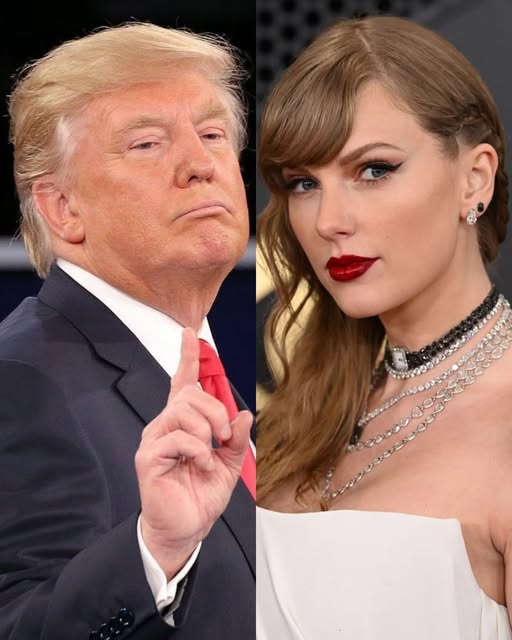
When a Pop Icon Speaks Like a Citizen, the Country Listens
The moment did not arrive with choreography or a rehearsed monologue. It came live, under studio lights, as national coverage shifted to the rollout of the Born In America Act and its public endorsement by former President Donald Trump. Taylor Swift, long known for strategic silence on many political flashpoints, leaned into the camera and spoke plainly. The restraint that has defined her public image gave way to a direct indictment of a system she said had crossed a moral line.
Her words cut through the broadcast with unusual force. Swift framed the policy not as an abstract debate over borders or paperwork, but as a rupture in daily American life—one that reaches into homes, workplaces, and neighborhoods. The thrust of her message was simple and unsettling: a government that uses fear as an enforcement tool forfeits the trust of the people it claims to protect.
At the center of Swift’s remarks was a condemnation of immigration enforcement practices that, in her view, have escalated into violence and intimidation. She described a country where families hesitate to answer the door, where workers fear routine commutes, and where citizenship itself feels conditional. “We no longer feel safe in our own homes or in our streets,” she said, distilling years of anxiety into a single sentence that resonated far beyond the studio.
The Born In America Act, promoted as a hardline recalibration of national identity, has been defended by its supporters as a necessary safeguard of sovereignty. Critics, however, argue that its implementation relies on aggressive tactics that blur the line between law enforcement and collective punishment. Swift aligned herself firmly with the latter view, asserting that policies rooted in exclusion corrode the Constitution they claim to uphold.
What made the moment remarkable was not only the content, but the delivery. Swift did not raise her voice. She did not trade in slogans. She spoke as a citizen describing a lived reality she believes millions share. By grounding her critique in everyday American rituals—working, paying taxes, burying parents, raising children—she reframed immigration enforcement as a question of belonging rather than legality alone.
Her direct attack on Trump was equally notable for its clarity. Swift accused him of draining the country’s moral foundation, arguing that leadership defined by spectacle and division reduces constitutional principles to props. In doing so, she placed responsibility not only on policy architects, but on the political culture that rewards escalation and cruelty.
The studio’s reaction underscored the gravity of the exchange. Silence followed—rare dead air in a medium engineered to avoid it. Then came a delayed eruption of response as producers cut away and the broadcast regained its footing. By that point, the moment had already escaped the confines of the studio. Clips spread across platforms within minutes, shared by fans and critics alike, reframed not as entertainment but as civic testimony.

Swift’s intervention lands at a time when public trust in institutions is fraying. Reports of ICE raids conducted with militarized force, accounts of mistaken detentions, and images of families separated at dawn have accumulated into a broader narrative of fear. For communities targeted by enforcement, the distinction between policy and personal safety has collapsed. Swift’s remarks echoed that reality, asserting that when enforcement becomes terror, legality loses its legitimacy.
Supporters of the administration’s approach argue that enforcement is necessary to uphold the rule of law. Swift did not dispute the existence of law; she challenged the method and the motive. Her argument was that laws enforced through fear erode the consent of the governed. When neighbors fear neighbors and children fear uniforms, the social contract fractures.
The backlash was immediate and predictable. Critics accused Swift of overreach, of politicizing her platform, of speaking outside her lane. Yet that critique misses the point she was making. Her claim was not one of expertise, but of citizenship. She did not present herself as a policy analyst. She presented herself as an American insisting that safety and dignity are nonnegotiable.
In American history, cultural figures have often served as early warning systems—voices that translate policy consequences into human terms. Swift’s remarks fit squarely within that tradition. By invoking her own roots and those of her audience, she rejected the notion that identity can be retroactively invalidated by political decree. Birth, work, contribution, and community, she argued, still matter.
The caption that followed the clip captured the essence of the moment: a denunciation of ICE violence and a declaration of lost safety. That framing explains why the remarks traveled so fast. They articulated a fear many feel but struggle to express—a sense that the boundaries of acceptable state power have shifted too far, too fast.
Whether Swift’s intervention changes policy is an open question. What is clear is that it changed the conversation. By refusing to soften her language or dilute her concern, she forced viewers to confront the human cost of political theater. In doing so, she reminded the country that democracy depends not only on laws, but on the shared belief that those laws exist to protect, not to terrorize.
Swift did not perform that night. She testified. And in a political climate saturated with noise, that distinction mattered.