For years, Mitch McConnell has been one of the most influential figures in the United States Senate. His long tenure, strategic approach to legislation, and ability to shape Republican priorities have made him a central figure in Washington politics.
Now, a headline circulating online declares that “McConnell is out” and that his replacement has already been named. The dramatic wording has sparked curiosity among political observers and raised an obvious question: What exactly is happening with McConnell, and who could take his place?
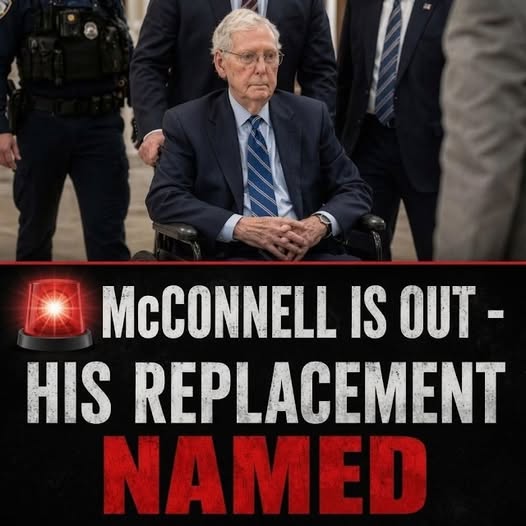
The image accompanying the headline shows McConnell seated in a wheelchair, surrounded by security personnel and other officials, with large text announcing that his replacement has been named. However, headlines like this can sometimes simplify a complicated political process. A leadership change, a decision not to seek another term, a retirement announcement, and an actual Senate succession are all different things.
McConnell’s political career has been unusually long and consequential. He first entered the Senate in 1985 after winning election in Kentucky, and he went on to become one of the longest-serving senators in American history. Over the decades, he established himself as a highly disciplined political strategist whose influence extended far beyond his home state.
His rise within the Republican Party was gradual.
McConnell eventually became Senate Republican leader, a position that placed him at the center of virtually every major legislative battle. He served as majority leader when Republicans controlled the Senate and later became minority leader when Democrats held the majority.
His influence became particularly significant during the administrations of Republican presidents, when Senate control played a crucial role in determining which nominees and legislative priorities could advance.
One of the most important aspects of McConnell’s career has been his approach to judicial appointments.
During his time as Senate majority leader, McConnell made the confirmation of federal judges a major Republican priority. The Supreme Court became a particularly important arena, and his leadership helped shape the ideological balance of the federal judiciary for decades.
Supporters have described that achievement as one of the most important accomplishments of his career.
Critics have argued that his approach contributed to increasing political polarization in Washington.
Regardless of political perspective, few observers would dispute the extent of McConnell’s influence.
That influence is precisely why speculation about his eventual departure generates so much attention.
When a politician has held a leadership position for many years, replacing that person is not simply a matter of finding another individual to occupy a chair. A change in leadership can affect the priorities, negotiating style, and internal balance of an entire political party.
The Senate Republican Conference would have to determine who should lead the party if McConnell stepped aside from leadership.
That process could involve competing candidates, private discussions among senators, negotiations over committee assignments, and questions about the direction Republicans want to take.
The most important distinction is between McConnell’s position as a senator and his position as Republican leader.
Those are not necessarily the same thing.
A senator can step down from a leadership role while remaining in the Senate.
Likewise, a senator can announce retirement from the Senate while continuing to serve until the end of a term.
And if a senator leaves office before the end of a term, the process for filling the Senate seat depends on state law.
This means that the phrase “McConnell is out” can have several possible meanings.
It could refer to his retirement from Senate leadership.
It could refer to his eventual departure from the Senate itself.
It could refer to a political transition that is still being discussed.
Or, in the context of a viral social-media headline, it could simply be a dramatic way of describing a developing political story.
The phrase “replacement named” can be equally misleading if it is not accompanied by specific information.
If McConnell were to leave his Senate seat, the identity of his successor would depend on the circumstances and applicable Kentucky law.
If he merely stepped down as Republican leader, however, his replacement would be chosen by Senate Republicans rather than by Kentucky voters.
These are two very different processes.
Understanding that distinction is important when reading sensational political headlines.
McConnell’s age and health have also attracted considerable attention in recent years. As one of the Senate’s longest-serving members, his physical condition has become a subject of public discussion.
He has experienced health-related incidents in public, including moments when he appeared to freeze or have difficulty responding during press conferences.
Those incidents prompted questions about whether he would continue serving and whether his responsibilities should change.
McConnell subsequently indicated that he intended to remain in the Senate, although his future role has naturally remained a subject of political speculation.
His decision-making has also been influenced by the changing Republican Party.
The Republican Party of today is different in important ways from the party McConnell helped lead for much of his career.
During the Trump era, internal debates within the party became increasingly intense.
McConnell and Donald Trump have had a complicated political relationship. At times, McConnell strongly supported major Republican objectives associated with the Trump administration. At other times, the two men publicly disagreed.
Their differences became especially visible following the 2020 presidential election and the events surrounding January 6, 2021.
Despite these tensions, McConnell remained a central Republican figure in the Senate.
His political style has traditionally emphasized institutional power, Senate procedure, judicial appointments, and long-term strategy.
Other Republican politicians have developed different approaches, particularly those more closely aligned with Trump’s political movement.
That difference in style could become an important factor in choosing future Senate leadership.
If McConnell eventually leaves his leadership position, Republicans will have to decide what kind of leader they want next.
Do they want someone who follows McConnell’s institutional approach?
Do they want a more openly populist leader?
Do they want a senator closely aligned with President Trump?
Or do they want someone who can bridge different factions within the Republican Conference?
Those questions could make the transition more significant than simply replacing one politician with another.
The Senate is a unique institution.
Unlike the House of Representatives, where party leadership is often more centralized, the Senate gives individual senators considerable influence.
A successful Senate leader must therefore be able to count votes, negotiate with members of their own party, work with the opposing party when necessary, and manage the complex rules of the chamber.
McConnell became particularly effective at this.
He developed a reputation for knowing the Senate’s procedures in extraordinary detail and for understanding how small changes in the political landscape could affect major legislation.
His ability to keep Republican senators largely united was one of the reasons he remained in leadership for so long.
Replacing someone with that level of experience would not be easy.
It would also raise questions about how Republicans would approach legislation.
A new leader could decide to emphasize different issues.
The party could place greater attention on immigration, national security, taxes, government spending, judicial appointments, energy policy, or other priorities.
The leader’s personality could also influence negotiations with Democrats and the White House.
In a closely divided Senate, even a small number of senators can have enormous influence.
That makes leadership elections especially important.
If McConnell were to leave his leadership position, Republican senators would have to balance loyalty, ideology, geography, seniority, and political ambition.
Several senators could potentially see the opportunity as a chance to shape the party’s future.
A leadership contest could therefore become a major political story in its own right.
But the image circulating online goes further by suggesting that the replacement has already been named.
That claim should be treated carefully unless it is supported by a clear, authoritative announcement.
Political succession is not always as simple as a headline makes it appear.
If the issue is Senate Republican leadership, the replacement must be selected through the appropriate internal Republican process.
If the issue is McConnell’s Senate seat, the process is different.
And if the headline refers to a future election, the successor would ultimately be determined by voters.
These distinctions matter because political headlines can easily create the impression that an important decision has already been finalized when the situation is actually still developing.
For Kentucky voters, the question of who could eventually succeed McConnell is especially significant.
McConnell has represented Kentucky in the Senate for decades.
During that time, he developed a powerful political organization and became one of the state’s most recognizable national political figures.
His departure would therefore create a major political opening.
Potential successors could come from several backgrounds.
Kentucky’s political leadership includes elected officials with experience at the state and federal levels, and a Senate vacancy involving such a high-profile seat would almost certainly attract considerable attention.
However, predicting a successor before the official process occurs would be premature.
The same is true of Senate leadership.
A politician who appears to be the obvious successor today may not necessarily become the next leader.
Political alliances can change quickly.
Senators may make decisions based on factors that are not visible to the public.
A candidate who seems unlikely at first may gain support during internal negotiations.
That is one reason Senate leadership contests can be difficult to predict.
McConnell’s legacy also complicates the question of replacement.
For his supporters, he represents a model of effective conservative governance and strategic discipline.
They point to his success in confirming conservative judges and advancing Republican priorities in the Senate.
For his critics, his tenure represents Washington’s increasingly confrontational political environment.
They argue that his leadership contributed to partisan gridlock and made compromise more difficult.
Both perspectives are likely to remain part of the debate over his eventual successor.
A new Republican leader would inherit not only McConnell’s position but also the expectations created by his long tenure.
That could be both an opportunity and a burden.
The successor would have to prove that they can maintain Republican unity while establishing an identity of their own.
They would also have to navigate the increasingly complicated relationship between congressional Republicans and the broader conservative movement.
Trump’s influence over Republican politics is particularly important in this context.
A future Senate Republican leader would likely have to work closely with Trump or, at minimum, understand the political priorities of Trump’s supporters.
That could represent a significant change from the style of leadership associated with McConnell.
At the same time, institutional Senate politics cannot simply be ignored.
A leader who focuses exclusively on public messaging may struggle to manage the internal negotiations required to pass legislation.
The most effective successor may therefore be someone capable of combining public political communication with the behind-the-scenes negotiation skills necessary to run the Senate.
This is why the transition could become one of the most important Republican leadership stories in Washington.
It is not simply about one senator.
It is about the direction of the Republican Party.
McConnell’s career has been defined by patience and strategy.
He often operated with long-term goals in mind, particularly when it came to the federal judiciary.
His successors may have different priorities.
They may face a political environment in which social media, presidential politics, and grassroots activism play an even greater role.
The Senate itself is also changing.
The institution has become more polarized, and bipartisan cooperation is often difficult.
At the same time, individual senators have enormous platforms and can influence national debates almost instantly.
A future leader will have to operate in that environment.
That person will need to understand not only Senate rules but also modern political communication.
The eventual transition could therefore mark the end of one political era and the beginning of another.
For ordinary Americans, however, the most important question may be what the change means for policy.
Leadership changes can influence which bills receive attention, which negotiations take place, and how the Senate responds to presidential priorities.
But leadership alone does not determine outcomes.
The composition of the Senate remains critical.
A party leader cannot pass legislation without enough votes.
That means the balance of power between Republicans and Democrats will continue to matter regardless of who succeeds McConnell.
The same is true for the White House.
Relations between the Senate and the president can determine whether major legislation moves forward or stalls.
A new Republican leader could therefore face a completely different political landscape depending on who controls the presidency and the Senate at the time of the transition.
This is why readers should be cautious about headlines that present succession as a simple, predetermined event.
Politics is rarely that straightforward.
The image’s message—“McConnell is out. His replacement named”—is designed to create urgency.
It invites readers to click, react, and find out who supposedly has been selected.
But a responsible understanding of the story requires more than a dramatic headline.
It requires knowing whether McConnell is leaving his leadership role, leaving the Senate, or simply facing speculation about his future.
It requires knowing who has actually been chosen, by whom, and through what process.
And it requires distinguishing confirmed facts from political predictions.
Whatever eventually happens, McConnell’s influence on the Senate is unlikely to disappear immediately.
His decisions over several decades have shaped the federal judiciary, Senate procedure, Republican strategy, and the broader political landscape.
His departure, whenever it occurs, will therefore represent a significant moment in American politics.
The person who follows him will inherit an institution with complicated challenges and a Republican Party undergoing its own transformation.
That successor will have to define a new era while dealing with the enormous shadow of the man who came before.
For now, the most important lesson from the viral headline is simple: dramatic wording does not necessarily mean every detail has been officially settled.
McConnell’s political future and the question of his eventual successor deserve careful attention, particularly because of the enormous influence he has had over the Senate.
If and when a transition occurs, it will be more than a change of personnel.
It will be a test of what Republican senators want their party to become.
Will they continue the strategic, institution-focused approach that defined McConnell’s leadership?
Will they embrace a more populist and confrontational style?
Will they attempt to find a compromise between competing factions?
Those questions will shape the next chapter of Republican Senate politics.
And whoever eventually takes the reins will face the difficult task of following one of the most consequential Senate leaders of the modern era.
For McConnell, the end of his leadership chapter—whenever it ultimately arrives—will close a remarkable period in American political history.
For Republicans, it will open a new one.
And for the Senate, it will provide another reminder of an enduring truth in Washington: political power may belong to individuals for a time, but eventually every generation must decide who comes next.