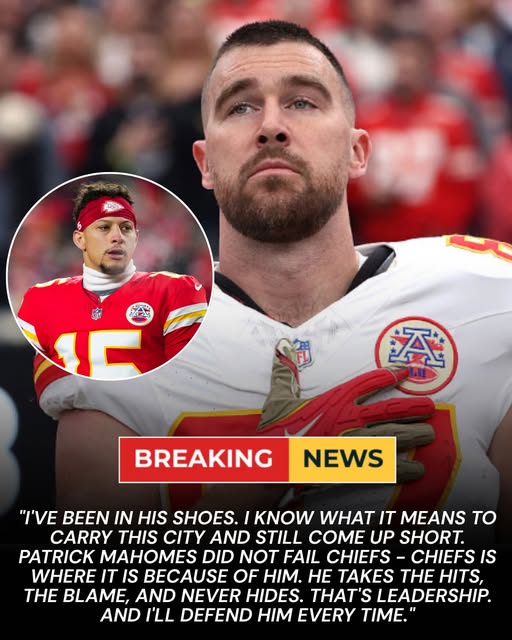
WHEN LOYALTY ROARS LOUDER THAN CRITICISM: Travis Kelce’s Fiery Defense of Patrick Mahomes Ignites a New NFL Debate
The Kansas City Chiefs were still reeling from another crushing playoff defeat when a familiar voice rose above the noise, as Travis Kelce finally broke his silence and sent shockwaves through the entire NFL community.
The loss had barely settled into memory when criticism erupted from every corner, targeting Patrick Mahomes with questions that felt sharper, louder, and more unforgiving than at any point in his career.
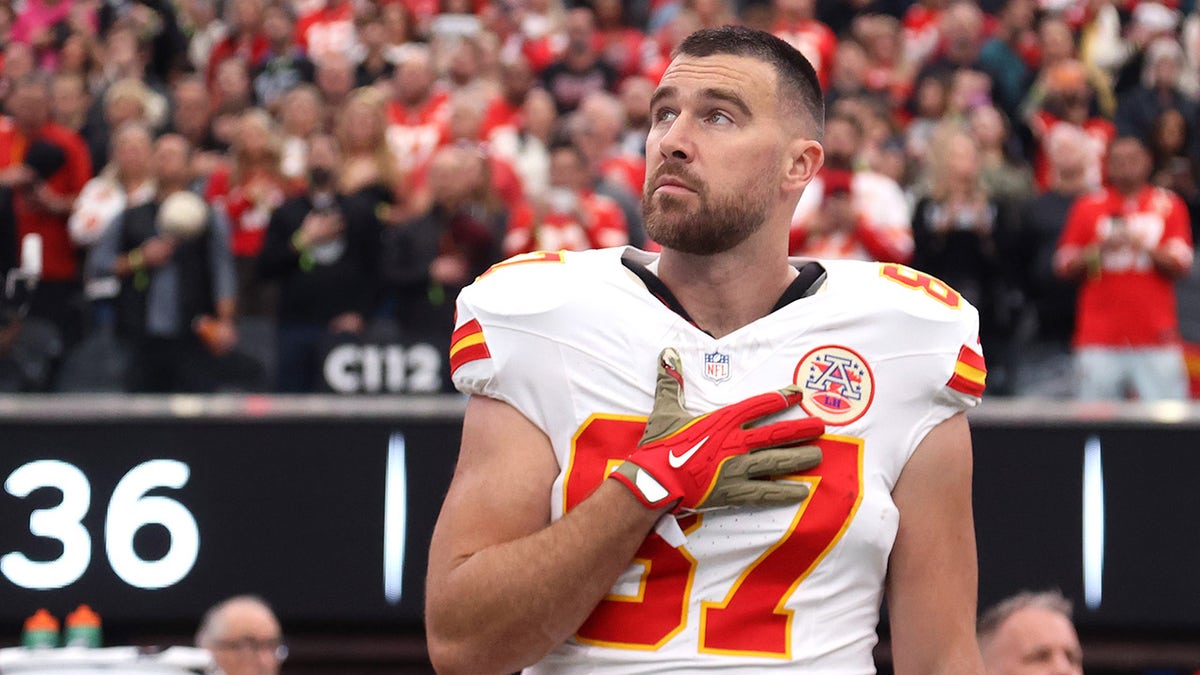
Talk shows, social media feeds, and comment sections filled with doubt, as armchair analysts questioned leadership, decision-making, and whether Mahomes could still carry the Chiefs through the league’s brutal postseason gauntlet.
That narrative, however, collided headfirst with Travis Kelce’s unapologetic message, a statement that did not attempt to soothe critics but instead challenged them directly and publicly.
Kelce did not speak as a former champion protecting a legacy, but as a teammate who has shared every collision, every comeback, and every heartbreak alongside his quarterback.
In his words, there was no hedging, no calculated public relations tone, only raw conviction that Patrick Mahomes represents everything this league claims to value but often forgets when results fall short.
Kelce reminded fans that leadership is not measured solely by rings or stat lines, but by the willingness to shoulder blame, absorb pressure, and continue standing tall when expectations turn suffocating.
The timing of Kelce’s message amplified its impact, arriving precisely when frustration threatened to reshape the narrative around Kansas City’s most important figure.

Rather than allowing criticism to harden into accepted truth, Kelce reignited the conversation, forcing fans, analysts, and former players to reconsider what fairness actually looks like in modern sports culture.
His defense of Mahomes was not subtle, as he called out the rapid shift from praise to condemnation that defines how quickly public opinion turns against even the most accomplished stars.
Kelce’s words carried weight because they came from someone who has seen Mahomes prepare in silence, compete through pain, and accept accountability even when the outcome disappointed millions.
This was not blind loyalty, but informed loyalty, forged through years of shared battles that most critics only observe from couches and studio desks.

Within minutes, Kelce’s message spread across social platforms, igniting fierce debates that split fanbases and dominated timelines far beyond Kansas City.
Some praised Kelce for defending his quarterback with honesty and courage, arguing that such public support strengthens locker rooms fractured by external pressure.
Others pushed back, claiming accountability requires criticism, and that emotional defenses risk shielding stars from legitimate evaluation after repeated postseason disappointments.
That clash of perspectives only fueled engagement, transforming Kelce’s statement into one of the most discussed moments of the NFL offseason.
At the heart of the controversy lies a deeper question about modern fandom, where devotion often collapses the moment winning becomes harder than expected.
Patrick Mahomes, once celebrated as the league’s golden standard, now finds himself judged against impossible expectations built by his own unprecedented success.
Kelce acknowledged that reality directly, pointing out how greatness warps perception until excellence becomes merely acceptable and anything less becomes grounds for outrage.
He emphasized that Mahomes has never hidden from responsibility, never deflected blame, and never demanded sympathy, even when criticism crossed into personal territory.
That reminder struck a nerve among longtime fans who remember eras when Kansas City dreamed of relevance rather than debating championship standards.
Kelce’s message reframed the loss not as a failure of character or effort, but as a painful chapter in a journey that remains unfinished.
The reaction from former players added another layer, with several echoing Kelce’s sentiment and warning against the erosion of loyalty within professional sports.
They argued that franchises and fanbases often celebrate grit and sacrifice, yet abandon those ideals when postseason margins swing the wrong direction.
As the debate raged, one truth became clear: Kelce’s defense was never meant to silence critics, but to expose the emotional cost of relentless scrutiny.
For Mahomes, the silence following Kelce’s words spoke volumes, suggesting a quarterback who allows his play and his teammates to speak on his behalf.
That restraint contrasted sharply with the noise surrounding him, further polarizing opinions about leadership styles in the modern NFL.
Some fans interpreted Mahomes’ quiet as strength, while others saw vulnerability, projecting their own expectations onto his demeanor.
Kelce challenged that projection, reminding everyone that leadership does not always announce itself loudly, especially in moments of disappointment.
He described moments unseen by cameras, where Mahomes absorbs frustration privately, then returns focused on improvement rather than image repair.
Those insights humanized a figure often treated more like a symbol than a person, complicating the simplistic narratives dominating postgame discourse.
As national media dissected every phrase, the Chiefs organization remained officially silent, allowing the conversation to unfold organically.
That silence only intensified speculation, with observers questioning whether Kelce’s message reflected broader locker room sentiment.
Many fans believe it does, arguing that internal trust remains the Chiefs’ greatest asset despite recent postseason frustrations.
Others worry that public defenses hint at underlying tension, suggesting fractures that loyalty alone cannot mend.
The controversy reveals how thin the line has become between constructive criticism and corrosive negativity in professional sports culture.
Kelce’s words forced fans to confront their own expectations, asking whether support is conditional upon perfection or resilient enough to survive disappointment.
For younger players watching from around the league, the moment served as a case study in teammate advocacy under public pressure.
It also highlighted the evolving role of star veterans, who increasingly shape narratives directly rather than allowing media intermediaries to define them.
As the offseason progresses, every Chiefs-related headline will be filtered through the lens of Kelce’s statement.
Wins will validate his loyalty, while losses will amplify critics who believe emotion cannot replace results.
That dynamic ensures the conversation will persist, resurfacing with every game Mahomes plays under heightened scrutiny.
Yet beyond wins and losses, Kelce’s message tapped into something deeper, a plea for perspective in an era addicted to instant judgment.
He reminded fans that football greatness is rarely linear, and that adversity often reveals more about character than success ever could.
Whether one agrees with Kelce or not, his words reshaped the narrative landscape surrounding Patrick Mahomes.
They transformed a routine cycle of criticism into a broader discussion about loyalty, leadership, and the cost of sustained excellence.
In Kansas City, the message resonated most strongly among fans who still believe championships are built on trust, not panic.
Those fans shared Kelce’s words relentlessly, turning them into rallying cries rather than defensive excuses.
The NFL thrives on debate, and this moment delivered it in abundance, blending emotion, legacy, and expectation into one combustible storyline.
As the dust settles, one thing remains undeniable: Travis Kelce refused to let Patrick Mahomes stand alone in the storm.
In doing so, he reminded the league that some bonds outlast losses, and that true leadership often reveals itself when silence would be easier.
Whether history views this moment as prophetic or misguided, its impact is already etched into the ongoing story of the Kansas City Chiefs.
Because in a league obsessed with results, Kelce dared to defend the person behind the performance, and that choice continues to echo far beyond the final whistle.
10 MINUTES AGO: Josh Allen’s wife “urgently” speaks out about her husband’s SECRET situation after the shocking defeat, astonishing the entire NFL… Bills teammates send heartfelt messages of support. Especially: The actions of Josh Allen’s close friend, Patrick Mahomes, moved his wife to tears and earned the admiration of the entire NFL community for their friendship!

10 minutes after the heartbreaking loss, the NFL world was shaken when Josh Allen’s wife urgently broke her silence. While fans focused on the scoreboard, her emotional revelation exposed a hidden reality that transformed a routine defeat into a story of pain, sacrifice, and unspoken courage.
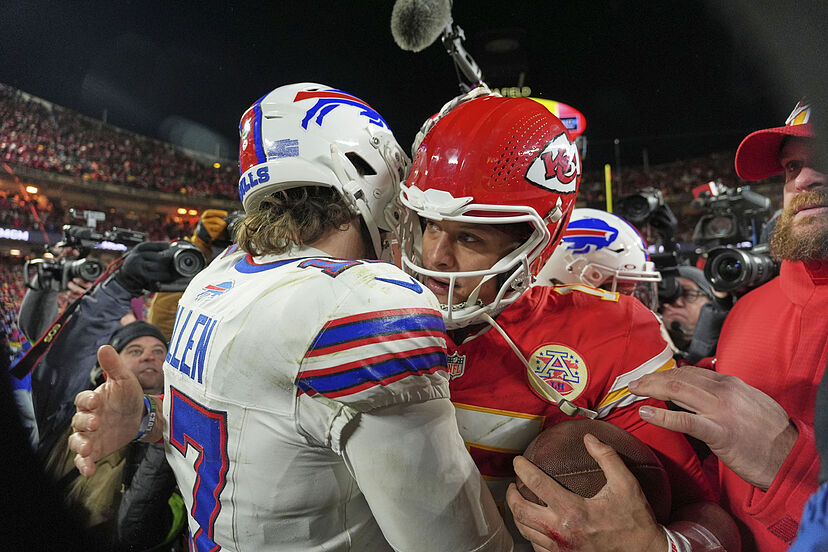
According to Hailee, Josh Allen had been silently battling a serious injury for nearly three weeks. Doctors strongly advised rest, warning that further impact could worsen the condition. Yet Allen chose to suppress the pain, believing his responsibility to the Buffalo Bills and their loyal fans came first.
The shocking truth centered on a fractured rib suffered during last week’s brutal clash against the Kansas City Chiefs. The injury was deliberately kept secret, as Allen feared revealing it would weaken team morale and shift focus away from collective goals during a crucial stretch of the season.
Despite the fractured rib, Allen delivered a remarkable performance, throwing for over 350 yards and two touchdowns. Many analysts now view those statistics with disbelief, questioning how a quarterback enduring such pain could maintain accuracy, mobility, and leadership under relentless defensive pressure.
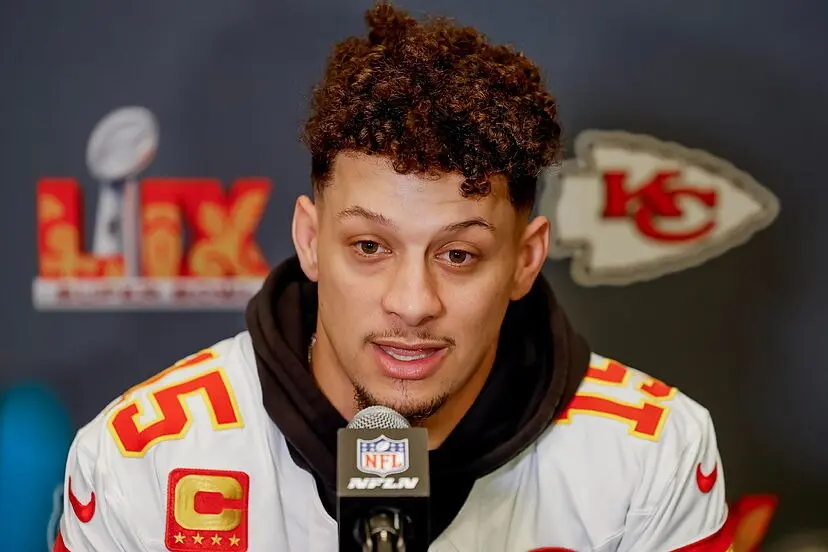
Hailee revealed that after the final whistle, Josh could barely stand. Team medical staff rushed to his side, administering emergency painkiller injections just so he could leave the field. Behind the scenes, the emotional toll was devastating, far removed from the heroic image fans saw on television.
“I cried all night worrying,” Hailee shared, describing the fear of watching her husband push beyond safe limits. Yet even in agony, Allen reportedly smiled and reassured her, saying the Bills would return stronger, reflecting the resilience that has defined his NFL career.
The revelation ignited immediate debate across the league. NFL insiders, including Adam Schefter, described the situation as both heroic and reckless. While praising Allen’s toughness, many questioned whether league protocols sufficiently protect star players from themselves and the pressure to compete injured.
Social media exploded with reactions from fans and players alike. Bills Mafia rallied behind their quarterback, flooding timelines with messages demanding stronger player safety measures. Hashtags like #ProtectOurQB trended rapidly, turning personal pain into a league-wide conversation about responsibility and risk.
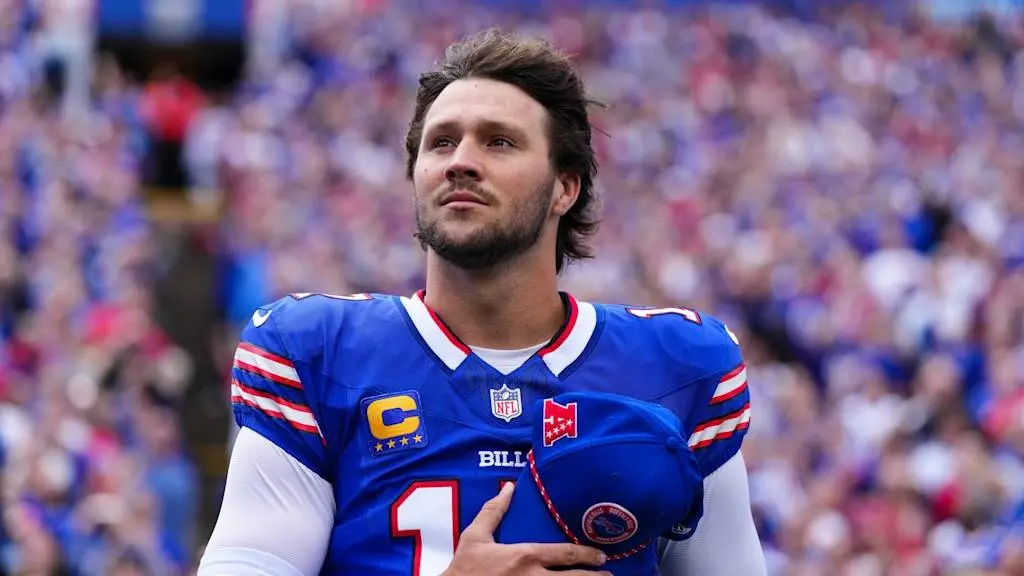
Even rival fanbases responded, including Broncos supporters who mixed respect with humor. Some jokingly asked whether “a wild horse broke a bone,” while still acknowledging the toughness required to perform at an elite level with a fractured rib in professional football.
Inside the Bills locker room, teammates sent heartfelt messages of encouragement. Several players praised Allen’s leadership, admitting they were unaware of the injury’s severity. The revelation strengthened team unity, reinforcing the idea that their quarterback had been carrying more than just offensive expectations.
Yet the most emotional response came from Allen’s closest friend and rival, Patrick Mahomes. Despite preparing for the AFC Championship, Mahomes reportedly video-called Allen immediately after the game, prioritizing friendship over rivalry in a moment that stunned fans.
What followed elevated the story beyond sports headlines. Mahomes arranged a private plane from Kansas City to Buffalo, carrying a top medical specialist for an emergency check-up. The gesture underscored a bond rarely seen at the highest level of competitive football.
Along with the doctor, Mahomes sent a massive bouquet of flowers and a handwritten letter addressed directly to Hailee. The message emphasized brotherhood, reassurance, and hope, reminding her that Josh was not facing this ordeal alone.
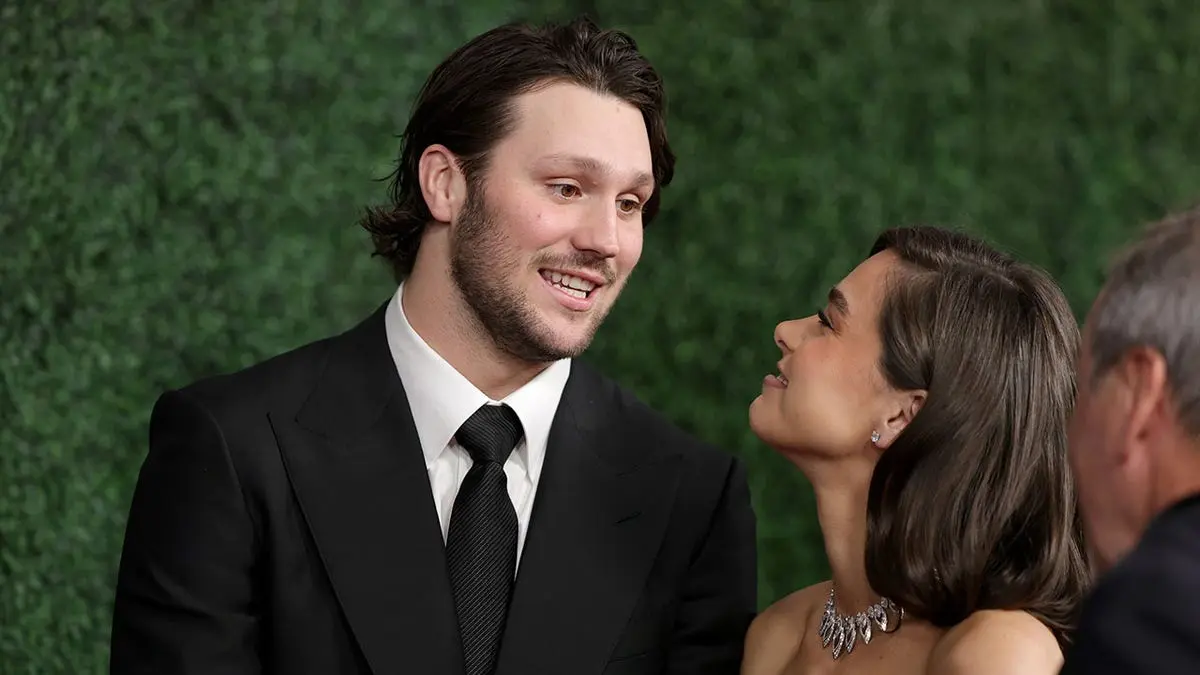
“Josh is like a brother to me,” Mahomes wrote, promising that Allen would recover and that future Chiefs versus Bills battles would remain legendary. The letter blended compassion with optimism, resonating deeply across the NFL community.
Hailee later reposted the letter alongside a video of herself in tears. Her caption thanked Mahomes for being a true friend, emphasizing that the NFL is not only about fierce rivalries, but also about shared humanity, mutual respect, and family.
Fans and analysts alike praised Mahomes’ actions as a rare example of empathy in a hyper-competitive league. Many called it a defining moment that showcased leadership beyond statistics, trophies, and championship aspirations.
The story has since reignited scrutiny of NFL injury management. Critics argue that players often feel pressured to hide pain, while teams benefit from silence. Allen’s fractured rib has become a symbol of the physical cost elite athletes quietly endure.
League officials have not yet commented directly, but sources suggest internal discussions are underway regarding injury disclosure and player autonomy. The situation has intensified calls for reforms that balance competitive integrity with long-term health.
For Josh Allen, recovery is now the priority. While his toughness has earned admiration, fans hope this episode encourages rest, transparency, and protection. His performance, once impressive, now feels almost unreal in light of the revealed suffering.
Ultimately, the real shock was not the injury itself, but the humanity behind it. From Hailee’s tears to Mahomes’ compassion, the story reminded the NFL world that behind every helmet is a person, and behind every rivalry is respect.