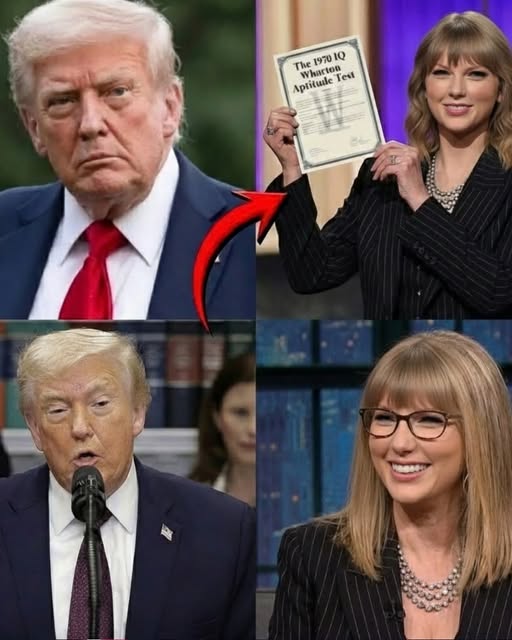
A Prime-Time Collision: How a Televised Exchange Between Taylor Swift and Donald Trump’s Longstanding “Genius” Narrative Set Off a Media Firestorm
The moment unfolded live, without warning, and instantly transformed a routine television segment into one of the most dissected broadcasts of the year. What began as a calm, methodical discussion led by Taylor Swift escalated into a cultural flashpoint that ricocheted across entertainment, politics, and social media within minutes.
Swift appeared composed from the outset. There was no raised voice, no theatrical buildup. Instead, she framed her remarks around a familiar public storyline: Donald Trump’s decades-long insistence on his exceptional intelligence, often anchored to his education at the Wharton School. For years, that claim has functioned as a pillar of Trump’s public image, repeated in interviews, speeches, and social posts.
Swift’s approach was deliberate. She did not attack Trump personally. She did not rely on sarcasm or mockery. Instead, she introduced documents that have circulated privately for years and have been the subject of quiet debate among journalists and biographers. On air, she contextualized them carefully, explaining when they originated, how they were referenced historically, and why they mattered to the broader conversation about public mythmaking.
As Swift walked viewers through the material line by line, the studio’s mood shifted. Audience laughter began tentatively, sparked not by jokes but by the contrast between Trump’s sweeping self-descriptions and the far more restrained language contained in the documents being discussed. That laughter grew, then abruptly stopped when one specific comparison landed with unexpected force. The silence that followed was broken only by a mix of gasps and uneasy applause.
What made the segment striking was its tone. Swift did not editorialize. She allowed Trump’s own past statements—aired side by side with the material under discussion—to create the contrast. The effect was cumulative. Each point added weight, steadily eroding the simplicity of the “stable genius” label that has long been central to Trump’s brand.
Television producers are trained to anticipate volatility, but few expected the aftermath. According to multiple individuals familiar with the situation, Trump was watching the broadcast live. His reaction, they say, was immediate and explosive. Aides described raised voices, pacing, and repeated demands for explanations about how the segment had been approved. One person characterized the episode as an extended outburst that dominated the next hour, consuming staff attention and halting other planned activities.
While Trump himself did not immediately address the segment publicly, the response online was instantaneous. Clips circulated at remarkable speed, accumulating millions of views in a matter of hours. The hashtag associated with the exchange trended across multiple platforms, pulling in commentators from across the political spectrum.
Media analysts were quick to weigh in. Some described the segment as a masterclass in restraint, noting that Swift avoided language that could be dismissed as partisan or inflammatory. Others criticized the decision to air such material in an entertainment setting, arguing that it blurred the already fragile boundary between news and late-night television.
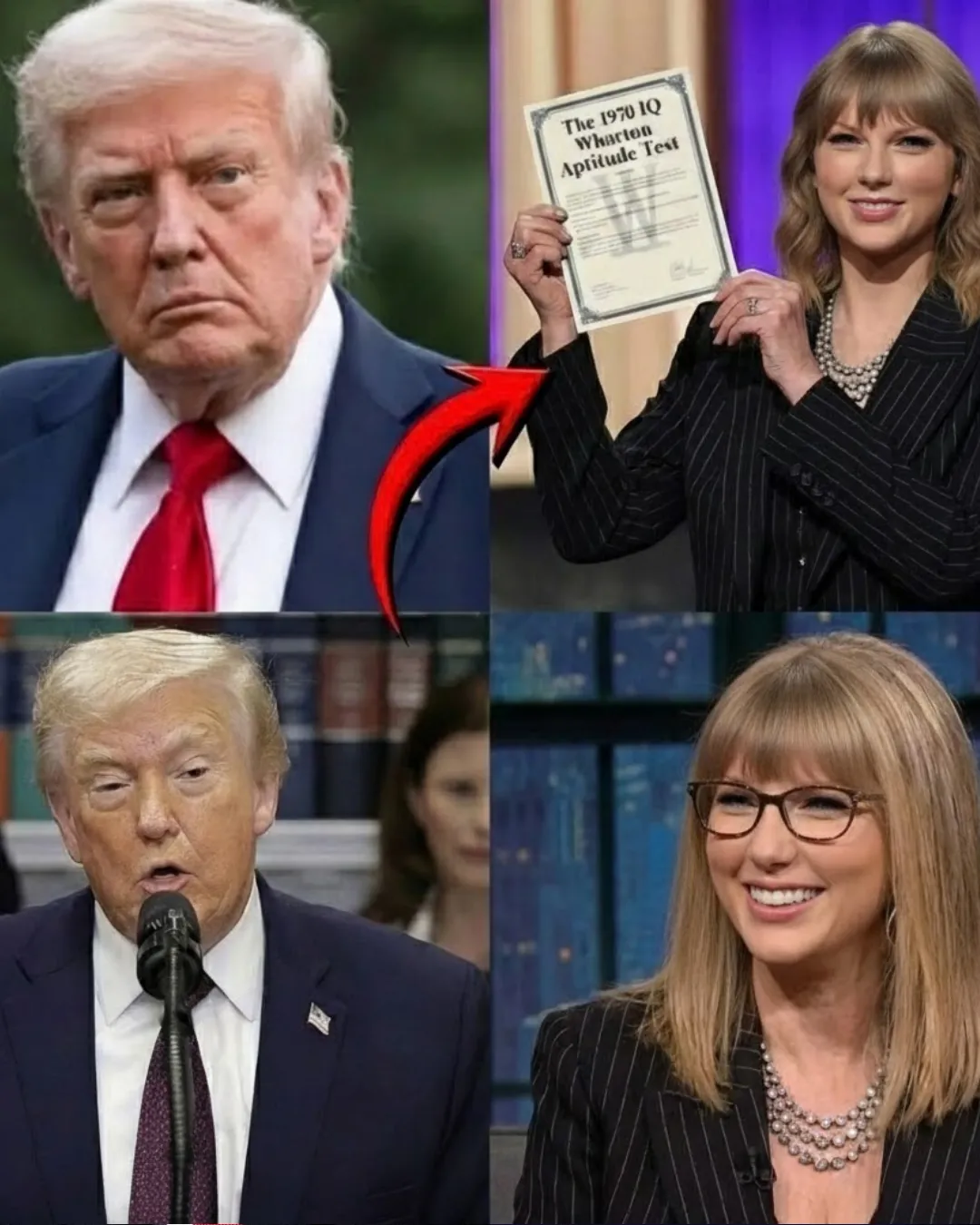
What most observers agreed on was the precision of the moment. Swift’s delivery was calm to the point of disarming. She did not appear interested in humiliating her subject; instead, she focused on how narratives are constructed and sustained. The implicit question threaded through her remarks was not whether Trump was intelligent, but why the claim of genius has been so central to his public persona—and what happens when that claim is examined rather than accepted.
Trump’s supporters moved quickly to defend him, dismissing the segment as a coordinated media attack and questioning the motives behind its timing. Allies emphasized his business career and electoral success as evidence that standardized measures were irrelevant. Critics, meanwhile, argued that the segment highlighted a long-standing pattern: bold self-mythologizing reinforced through repetition rather than scrutiny.
The broadcast also reignited debate about celebrity influence. Swift, one of the most powerful figures in global entertainment, occupies a unique position. When she speaks, audiences listen far beyond the confines of a single show. That reach prompted questions about responsibility—both hers and that of the networks that host her. Should entertainers challenge political figures directly? Or does doing so risk transforming complex issues into spectacle?
Late-night television has increasingly become a site for these collisions. Humor, commentary, and cultural critique now share the same space, often uncomfortably. In this case, humor receded almost entirely. What remained was an examination of credibility, conducted in front of millions, without the familiar buffer of jokes.
As the segment drew to a close, Swift added one final line, delivered almost casually, as if summing up rather than concluding. Those present describe it as measured and reflective, a statement about truth and narrative that reframed the entire exchange. It was not a punchline. It was a thesis.
That sentence, clipped and widely shared, continues to echo through the conversation surrounding the broadcast. Supporters see it as a reminder that power often rests not in volume but in control of the story. Detractors view it as overreach. Either way, it ensured the moment would not fade quickly.
In the days since, the ripple effects have continued. Commentators revisit Trump’s past statements with renewed scrutiny. Media organizations debate editorial standards. Viewers argue about whether the segment represented accountability or ambush.
What cannot be disputed is its impact. In a media environment saturated with outrage, the exchange stood out precisely because it avoided it. Swift did not shout. She did not accuse. She presented, contrasted, and stepped back.
The result was a rare kind of television moment—one that unsettled not through spectacle, but through composure. And in doing so, it forced a reassessment of a narrative that has long gone largely unchallenged in real time.
When the cameras cut and the studio lights dimmed, the conversation was only beginning.