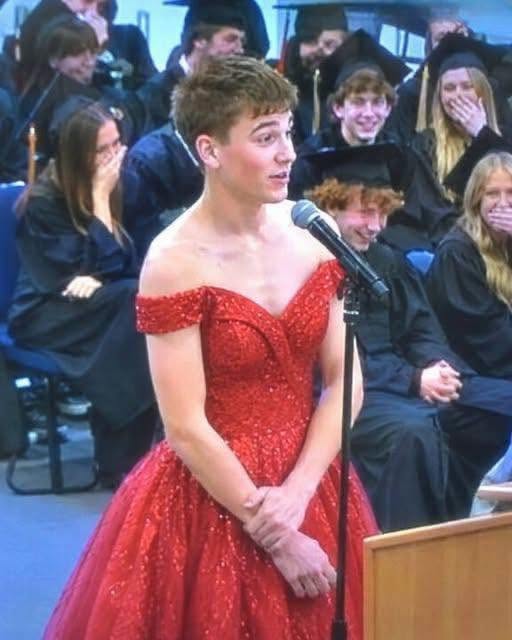
The school auditorium buzzed with conversation as students, parents, teachers, and staff settled into their seats. Bright stage lights illuminated the polished wooden floor, casting long shadows across the room. It was supposed to be another ordinary school presentation, one of those annual events where students shared projects that reflected their creativity and personal growth.
Instead, it became a day that no one present would ever forget.
I stood quietly near the back of the auditorium, trying to blend into the crowd. My palms were damp, and my thoughts raced faster than I could calm them. Watching your child step onto a stage is always emotional, but this felt different. I knew Liam had spent months preparing for this presentation, yet he had revealed almost nothing about it. Every time I asked what he was planning, he simply smiled and told me to trust him.
As his name echoed through the speakers, Liam walked onto the stage with calm confidence. He wasn’t wearing the usual shirt and tie that many of the other students had chosen. Instead, he appeared in a flowing crimson garment that immediately drew everyone’s attention.
The room fell silent for only a brief moment.
Then whispers began.
Those whispers quickly grew louder until scattered laughter spread across the auditorium. Some students exchanged amused glances. Others pointed toward the stage, unable to hide their surprise. A few adults looked uncomfortable, unsure how to react.
Standing where I was, every second felt painfully long.
No parent wants to see their child become the center of unwanted attention. My heart sank as I listened to the reactions around me. I wondered if Liam had anticipated this response—or if he was now facing something far more difficult than he had expected.
Yet he never hesitated.
He continued walking toward the podium with steady steps, neither rushing nor slowing down. His shoulders remained relaxed, and his expression showed neither embarrassment nor frustration. He simply waited.
The laughter gradually faded.
Curiosity began replacing amusement.
Liam adjusted the microphone and looked across the audience before speaking.
“Many of you are probably wondering why I’m dressed this way today,” he said with a calm, measured voice. “Some of you may have already decided what this outfit means.”
The auditorium became noticeably quieter.
“It’s easy to make assumptions when we only look at the surface,” he continued. “Sometimes we see something different and immediately create a story in our minds before learning the truth.”
His words carried through the room with surprising confidence. Every sentence seemed carefully chosen.
I realized then that my son wasn’t nervous at all.
He had prepared for this moment.
Watching him speak reminded me of how much he had grown over the years.
I became a mother when I was just nineteen years old. Like many young parents, I spent countless nights wondering whether I was making the right decisions. Every milestone brought new questions. Was I providing enough support? Was I creating a stable home? Would Liam grow into a confident, compassionate person despite the challenges we faced?
Life wasn’t always easy.
There were months when paying the bills required careful planning. There were birthdays that had to be celebrated simply because expensive gifts weren’t possible. There were evenings when I questioned every parenting decision I had ever made.
Through all of it, Liam rarely complained.
He was the kind of child who noticed the feelings of others. While many children focused only on themselves, Liam paid attention to the people most overlooked.
He greeted office staff by name.
He thanked cafeteria workers every day.
He smiled at custodians in the hallway instead of walking past them.
At the time, I thought it was simply good manners.
I never realized those small conversations were becoming meaningful friendships.
Back on stage, Liam paused before continuing.
“For the past several months,” he said, “I’ve been working on a project that isn’t really about me.”
Several audience members leaned forward.
“It’s about the people we see every day without truly noticing.”
The room had become completely silent.
He explained that his assignment had encouraged students to create something representing community. While many students chose traditional presentations, Liam decided to create something different.
Instead of interviewing classmates or researching historical figures, he spent months speaking with the employees who quietly kept the school running.
He arrived early in the mornings.
He stayed after classes ended.
He listened.
He learned.
He discovered stories that many students had never heard.
“There are people who unlock these doors before sunrise,” Liam explained. “Others prepare breakfast before most of us wake up. Some stay long after school ends to clean classrooms so they’re ready for another day.”
He looked around the auditorium.
“They’re part of our lives every day.”
His voice remained gentle.
“But how many of us know their names?”
The question lingered in the silence.
I noticed teachers exchanging thoughtful glances.
Several students who had laughed earlier now looked uncertain.
Liam continued by describing conversations with custodians, cafeteria employees, administrative assistants, maintenance workers, and crossing guards. Each person had shared stories about dedication, family, sacrifice, and pride in their work.
“They don’t ask for applause,” he said.
“They don’t expect recognition.”
“They simply show up every day because they care about helping others.”
Then he looked down at the garment he was wearing.
“This wasn’t chosen because I wanted attention.”
He gently touched the fabric.
“It was created to tell their stories.”
For the first time, the audience seemed to truly see what he was wearing rather than simply reacting to it.
The deep red fabric wasn’t plain at all.
Subtle embroidered designs stretched across it, woven into intricate patterns that many people had overlooked from a distance.
Each detail had meaning.
Each stitch represented someone whose work often went unnoticed.
The auditorium remained completely still as Liam prepared to explain what those symbols meant.
No one laughed anymore.
Everyone was listening.