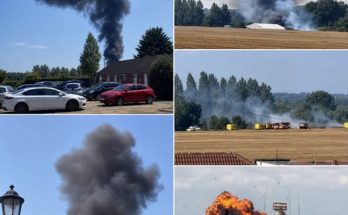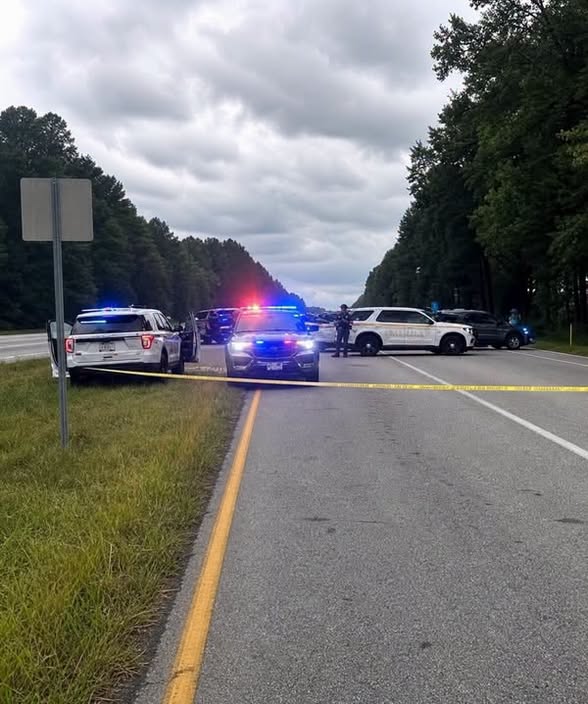
Only minutes earlier, the neighborhood had been completely ordinary. Cars moved through familiar streets, children were getting ready for school, buses followed their usual routes, and people were beginning another routine day.
Within minutes, an ordinary neighborhood had been transformed into a locked-down red zone, and almost nobody seemed to know why.
Families found themselves trapped behind windows, watching flashing emergency lights paint the walls of their homes in red and blue.
The suddenness was almost as frightening as the silence that followed.
No simple answer that could tell residents whether they were safe or whether they needed to leave.
Someone claimed there had been an explosion.
Another person insisted they had heard gunfire.
Someone else said a dangerous suspect was nearby.
And with every unanswered question, the fear grew.
Authorities insisted that the truth was too sensitive to release immediately.
That explanation did little to calm people who were watching police vehicles gather outside their homes.
Neighbors began speaking in hushed tones through half-open doors, glancing toward one another before looking back at the barricades that had suddenly divided their streets.
People who had exchanged casual greetings for years were now asking the same question:
Parents kept their children away from the windows.
Some tried to make the situation sound ordinary.
But even as they tried to reassure their children, helicopters circled overhead and loudspeakers crackled with instructions that were difficult to understand.
The atmosphere made it impossible to pretend this was completely normal.
Traffic disappeared from streets that were normally busy.
And behind curtains and blinds, residents watched the emergency response unfold without understanding what had triggered it.
The strangest part wasn’t necessarily the number of police vehicles.
When people know what they’re facing, fear can at least be directed toward something.
When they don’t know, the imagination fills the gap.
Every loudspeaker announcement seems to contain a hidden message.
Inside the cordon, officers moved with deliberate focus.
They appeared organized and controlled, moving from one position to another with the kind of concentration that suggested they understood something the public didn’t.
Their silence seemed to say more than any press briefing.
Outside the perimeter, however, people had nothing but time.
Time to search for information that wasn’t there yet.
Some residents called relatives to tell them they were safe.
Some simply stood at their windows, trying to understand why their familiar neighborhood suddenly looked like the setting of a completely different city.
For families trapped inside the affected area, the uncertainty became exhausting.
Nobody wanted to make the wrong decision.
And nobody wanted to panic unnecessarily.
That is the difficult space communities enter during an active emergency.
People have to trust authorities while knowing that authorities cannot always reveal everything immediately.
There are situations in which information must be withheld temporarily because releasing it could compromise an investigation, endanger officers, reveal sensitive locations, or create additional risk.
And information vacuums rarely remain empty.
Messages are forwarded without verification.
Fear turns uncertainty into certainty long before the facts arrive.
That is why those outside the cordon were living in a strange contradiction.
They were being asked to trust the authorities.
But they were also desperate for information.
They wanted to know what was happening in their own neighborhood.
They wanted to know whether their children were safe.
They wanted to know whether the danger was nearby or already contained.
And above all, they wanted to know when they could go back outside.
Inside the restricted area, officers continued working.
Whatever threat existed had to be identified and contained.
Every decision mattered because the public didn’t yet know the full picture.
Outside, life narrowed to waiting and watching.
Phones became the primary source of information.
Messages came in from friends asking what was happening.
Family members called from other parts of the city, worried because they had seen the emergency vehicles on television or social media.
It might have been contained inside a small area.