Savannah Guthrie had just slipped off her heels and placed her phone face-down on the kitchen counter, ready to reclaim a quiet sliver of evening with her family. The day had been long—meetings, scripts, breaking news banners, the relentless pulse of a newsroom that never truly sleeps. At home, however, there was stillness. The scent of roasted garlic drifted from the oven. The low hum of the dishwasher underscored the faint laughter of children in the living room.
When the phone buzzed, it vibrated against the granite with an urgency that felt different.
Unknown number.
Normally, she would let it go to voicemail. But something—a flicker of instinct sharpened by years of reading tone, cadence, and context—compelled her to answer.
“Hello?”
There was a brief shuffle of static. Then a voice.
“Ms. Guthrie? This is Lieutenant Harris with the Metro Police Department. We need to inform you of something regarding your mother.”
The words landed with a weight that bent time.
Savannah’s mind moved instantly into two modes at once—the daughter and the journalist. The daughter felt the rush of heat in her chest, the involuntary tightening of her throat. The journalist listened for precision. Tone. Specificity.
“Yes,” she said carefully. “What is it?”
“We’ve detected a signal,” the lieutenant replied. “A signal that appears to be coming from your mother’s emergency beacon device.”
The kitchen felt suddenly smaller.
Her mother’s emergency beacon.
It had been purchased years ago—more out of reassurance than necessity. A small, unobtrusive device that could transmit a signal if activated. A safeguard. A “just in case.”
But there was a problem.
Her mother had been declared missing ten days earlier.
And the last place anyone had seen her was miles from where any signal should reasonably be detected.
Savannah steadied herself against the counter.
“A signal?” she repeated. “That’s not possible.”
“That’s what we thought,” Lieutenant Harris admitted. “But at 5:42 p.m., our monitoring system picked up a low-frequency ping registered to your mother’s device ID.”
Savannah’s heart began to pound.
“Where?” she asked.
There was a pause.
“That’s the strange part,” he said. “It’s coming from the northern perimeter of Crescent Ridge Forest.”
Crescent Ridge.
The name echoed in her mind like a struck bell.
Her mother had always loved Crescent Ridge. The tall pines. The winding trails. The way the light filtered through the canopy like stained glass in motion. She had walked those paths countless times over the years, often alone, always confident.
But ten days ago, she hadn’t come home.
Her car had been found in the small gravel parking lot near Trailhead C. Her phone had been discovered in the passenger seat. Her purse untouched.
No signs of struggle.
No witnesses.
Just absence.
Search teams had combed the forest. Helicopters with thermal imaging had scanned from above. Volunteers had walked in lines, eyes down, calling her name into the trees.
Nothing.
Until now.
Savannah’s mind flicked through the details with frightening clarity.
“Is it a strong signal?” she asked, her voice steady despite the storm inside.
“It’s faint,” Harris said. “Intermittent. But consistent enough that we’re confident it’s not interference.”
“Could it have been triggered accidentally?”
“It’s possible. But the beacon requires deliberate pressure for three seconds.”
Savannah closed her eyes.
Three seconds.
Her mother had pressed it.
Somewhere in Crescent Ridge.
“Are you sending a team?” Savannah asked.
“We already have one en route. We wanted to inform you immediately.”
The journalist in her registered the phrasing.
Inform you.
Not update.
Not reassure.
Inform.
“Lieutenant,” she said quietly, “is this a recovery operation?”
Another pause. This one longer.
“We don’t know yet.”
The line clicked softly as the call ended, but Savannah remained frozen, phone still pressed to her ear.
In the living room, laughter erupted again—carefree, unburdened.
For a moment, she envied it.
Then she straightened.
Ten days of waiting had been an exercise in suspended reality. Interviews with investigators. Carefully worded public statements. Quiet hope she refused to extinguish.
Now there was movement.
She walked into the living room. Her husband looked up immediately, reading her face with the intimacy of someone who knows every nuance.
“What is it?” he asked.
“There’s been a signal,” she said.
The room shifted.
The children sensed it before they understood it.
“Grandma?” one of them asked softly.
Savannah knelt.
“Yes,” she said. “They think Grandma pressed her emergency button.”
“Does that mean they found her?” another asked.
“It means,” Savannah said carefully, “that they’re looking right now.”
The drive to Crescent Ridge felt longer than ten days.
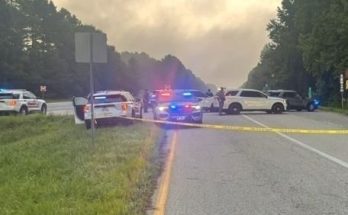
The forest was already cloaked in early evening shadow by the time she arrived. Police cruisers lined the gravel entrance, red and blue lights pulsing silently against the trunks of ancient trees.
She stepped out of her car and was met by Lieutenant Harris—a tall, weathered man whose expression carried both professionalism and something softer.
“We’re tracking the signal,” he said. “It’s moving.”
Savannah’s breath caught.
“Moving?”
“Not quickly. But yes.”
The implications rippled outward.
If the beacon was moving, either someone was carrying it—
—or her mother was.
They walked toward a mobile command unit where a small team monitored a screen displaying a topographical map. A blinking dot pulsed weakly near a dense cluster of elevation lines.
“That’s her?” Savannah asked.
“That’s the device,” Harris clarified.
She appreciated the distinction.
“How far in?” she asked.
“About three miles from the main trail. Rough terrain.”
Three miles.
Her mother was seventy-three.
But she was also stubbornly independent. Fiercely so.
Savannah remembered the argument just last year.
“I don’t need supervision to walk in the woods,” her mother had insisted.
“I know you don’t,” Savannah had replied. “But just… take the beacon.”
“I will,” her mother had sighed. “For your peace of mind.”
Peace of mind.
Now that small concession had become a lifeline.
“We’re sending a second team in from the north to triangulate,” Harris said. “If the signal holds, we’ll narrow it down within the hour.”
An hour.
Time stretched again.
Savannah stood at the edge of the forest, staring into its layered darkness. The trees seemed indifferent. Silent witnesses to something they refused to reveal.
She thought about the last conversation she’d had with her mother.
It had been ordinary.
That was the cruelty of it.
They’d discussed recipes. A book her mother was reading. The children’s school projects. No grand declarations. No sense of impending rupture.
Just life.
She wondered now: Had there been a hint? A tone? A hesitation she’d missed?
The radio on Harris’s shoulder crackled.
“Unit Three to Command. We’ve got visual on a reflective object about fifty yards east of the ping.”
Savannah’s pulse roared in her ears.
“What kind of object?” Harris asked into the radio.
“Can’t confirm yet. Possibly fabric.”
Fabric.
Savannah gripped the edge of the command table.
Minutes crawled.
Then—
“Command, we’ve located a backpack. Appears to belong to the missing person.”
Savannah inhaled sharply.
“My mother carried a blue canvas backpack,” she said. “With a stitched sunflower on the side.”
Another pause.
“Confirmed. Blue canvas. Yellow sunflower patch.”
Savannah’s knees threatened to give way.
“That’s hers,” she whispered.
“Is there any sign of her?” Harris asked.
The radio hissed with static before the reply came.
“Stand by.”
Stand by.
Two words that had defined her professional life.
Now they felt unbearable.
The forest seemed to lean inward.
Savannah imagined her mother sitting somewhere in that vastness—cold, tired, but alive. She imagined her calling out, conserving strength, waiting.
Or worse—
No.
She would not let her mind go there.
The radio crackled again.
“Command, we’ve got tracks leading downhill. Looks like someone slipped. There’s disturbed soil.”
Harris exchanged a glance with Savannah.
“She may have fallen,” he said quietly.
Savannah nodded.
Her mother had always walked confidently, but the terrain at Crescent Ridge could be deceptive—loose gravel, hidden roots, steep inclines.
“Following tracks,” the voice continued. “Signal’s stronger now.”
Stronger.
Hope flared dangerously.
“How much stronger?” Harris asked.
“Reading at sixty percent.”
Savannah’s heart pounded so loudly she could barely hear.
Then—
A different voice came through the radio.
“Command, we’ve got a response.”
Harris leaned in.
“Repeat.”
“We called out her name. We got a faint reply.”
The world tilted.
Savannah’s hand flew to her mouth.
“She’s conscious,” the voice continued. “Weak, but responsive.”
Tears sprang to Savannah’s eyes, unrestrained.
“Is she injured?” Harris asked.
“Possible leg injury. She’s at the base of a small ravine. Appears she slid down. Unable to climb back up.”
Savannah exhaled a sob she hadn’t realized she was holding.
Ten days.
Ten days alone.
“How is she?” she whispered.
The radio crackled.
“She says she’s glad you answered the phone.”
Savannah blinked through tears.
“Answered the phone?” she repeated.
“Her words,” the voice said.
Savannah let out a shaky laugh that was half sob.
Her mother had always believed in connection. In picking up when someone called. In not letting messages go unanswered.
It was a small philosophy.
But it had kept her alive.
Rescue crews worked swiftly but carefully. Darkness settled fully over the forest, but floodlights illuminated the ravine in bright, artificial day.
Savannah was kept at the perimeter until her mother was stabilized and lifted on a stretcher.
When they finally brought her up, wrapped in thermal blankets, face pale but unmistakably alive, Savannah felt the earth steady beneath her.
Her mother’s eyes fluttered open.
There was confusion at first.
Then recognition.
“Oh,” her mother murmured weakly. “You came.”
Savannah knelt beside the stretcher, tears spilling freely now.
“Of course I came,” she said. “You pressed the button.”
Her mother gave the faintest smile.
“Took me three tries,” she whispered. “My hands were shaking.”
Three tries.
Three seconds.
Three chances.
“You stayed so strong,” Savannah said, brushing a strand of hair from her mother’s forehead.
Her mother’s gaze softened.
“I kept thinking,” she said slowly, “that you’d be listening.”
Savannah swallowed hard.
“I was,” she said.
At the hospital later that night, doctors confirmed a fractured ankle, mild dehydration, and exhaustion—but no life-threatening injuries.
Ten days.
Ten days sustained by sheer will and a small stream she’d found at the base of the ravine.
“You’re not supposed to be stubborn at seventy-three,” Savannah teased gently from the chair beside her hospital bed.
Her mother chuckled weakly.
“Seventy-three isn’t that old.”
Savannah shook her head, smiling through tears.
“No,” she agreed. “It’s not.”
The forest would remain what it had always been—vast, beautiful, indifferent.
But for Savannah, it would now hold something else.
Proof that hope, however faint, can pulse steadily beneath layers of doubt.
Proof that sometimes a signal—weak, intermittent, nearly lost—can still be found.
As dawn began to lighten the hospital window, Savannah sat quietly, listening to the steady rhythm of the heart monitor beside her mother’s bed.