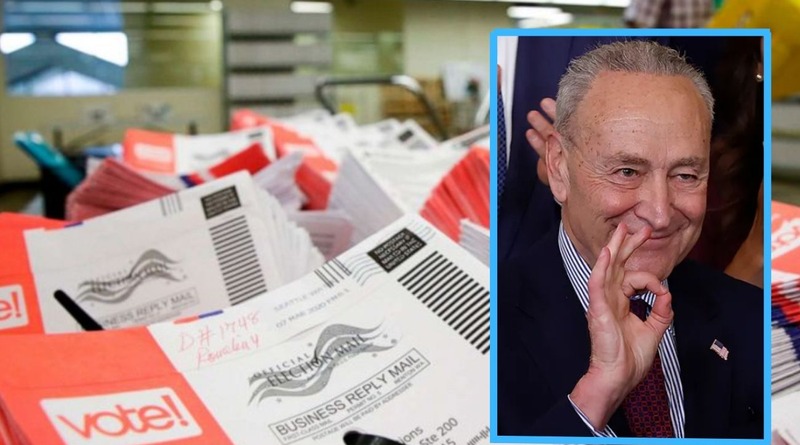
The U.S. Supreme Court on Monday heard oral arguments in a closely watched case that could determine whether states may count mail-in ballots received after Election Day in federal elections.
The U.S. Supreme Court on Monday heard oral
The U.S. Supreme Court on Monday heard oral arguments in a closely watched case that could determine whether states may count mail-in ballots received after Election Day in federal elections.
The case, Watson v. RNC, challenges a Mississippi law that permits absentee ballots to be counted if they are postmarked by Election Day but received up to five days afterward. Fourteen states and the District of Columbia have similar provisions allowing ballots to arrive after Election Day so long as they are timely mailed.
At issue is whether federal law establishing a single Election Day for federal contests requires ballots to be received by that date, or whether states retain discretion to count ballots that arrive later but are postmarked on time.
During oral arguments, Justice Samuel Alito focused on the statutory meaning of “Election Day,” questioning whether the phrase itself implies a firm deadline.
“We have lots of phrases that involve two words, the last of which, the second of which is ‘DAY’,” Alito said from the bench. “Labor Day, Memorial Day, George Washington’s birthday, Independence Day, and Election Day.”
“And they’re all particular days,” he continued. “So if we start with that, if I have nothing more to look at than the phrase election day, I think this is the day in which everything is going to take place, or almost everything.”
The comments came as attorneys debated whether Congress
The comments came as attorneys debated whether Congress, by setting a federal Election Day, intended to require that ballots be both cast and received by that date.
Lawyers representing the Republican National Committee argued that federal statutes fix a single day for choosing electors and members of Congress, meaning ballots must be in the hands of election officials by the close of polls. They contend that allowing ballots to arrive days later extends the election beyond the date set by Congress.
Supporters of Mississippi’s law argued that states have long administered the mechanics of elections and that receipt deadlines tied to postmarks fall within that authority. They also pointed to practical concerns involving mail delivery and military or overseas voters.
Under Mississippi’s statute, absentee ballots must be postmarked by Election Day and received within five days to be counted. Illinois permits ballots to arrive up to 14 days after Election Day if postmarked on time.
Advocates for stricter deadlines argue that federal law is clear and that counting ballots after Election Day undermines uniformity in federal elections. Jason Snead, executive director of the Honest Elections Project, told The Center Square that Congress has already spoken on the issue.
Federal law clearly states that ballots must be
“Federal law clearly states that ballots must be received by Election Day,” Snead said. “Despite this, states continue to allow absentee ballots to pour in days or even weeks late.”
Others note that late-arriving ballots became more common during the COVID-19 pandemic, when expanded absentee voting was implemented across many states.
Congress previously enacted the Uniformed and Overseas Citizens Absentee Voting Act, which requires states to send absentee ballots to military and overseas voters at least 45 days before federal elections. Attorneys defending Mississippi’s law argue that a strict receipt rule could affect those voters if postal delays occur.
Polling cited by advocacy groups reflects broad public interest in the issue. According to a survey conducted by CRC Research for the Honest Elections Project between March 12 and March 17 among 1,600 likely voters, 78% said requiring ballots to be received by the end of Election Day makes elections more secure. The poll found 90% of likely Republican voters, 77% of independents, and 68% of Democrats agreed with that statement.
The justices are not expected to issue a decision until late June. A ruling could clarify whether federal Election Day statutes require receipt of ballots by that date or allow states to accept ballots that arrive afterward so long as they were mailed on time.