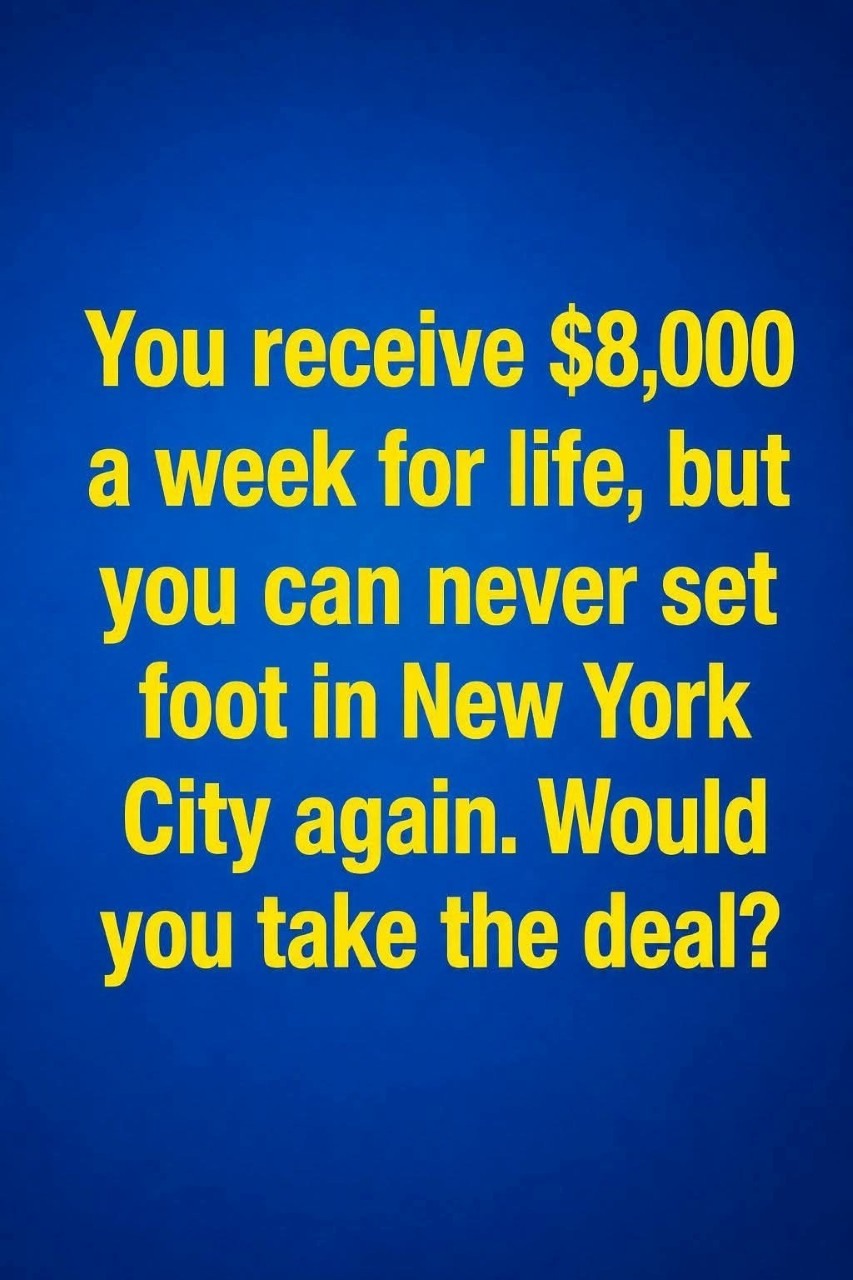
Yes, I probably would take the deal — and I say that with a lot more hesitation than most people expect.
At first glance, it sounds absurdly easy. $8,000 a week for life is about $416,000 a year guaranteed. No meetings. No boss. No layoffs. No worrying about retirement. That’s the kind of money that completely changes a person’s relationship with stress, time, and freedom.
But the real question isn’t about money.
It’s about what a place means to you.
For some people, New York City is just another city. If that’s the case, the answer is easy: take the money immediately. There are thousands of amazing places in the world to live and visit. You could spend your life traveling through Europe, Asia, South America, national parks, beaches, mountains, small towns, and still never see everything. Losing one city — even a famous one — would barely matter.
But for other people, New York is emotional. It’s identity. It’s memory. It’s ambition. Some people fell in love there. Some built careers there. Some grew up there. Some see it as the center of energy and possibility. If you’re one of those people, this deal becomes much harder because you’re not trading geography for money — you’re trading part of yourself.
That’s why I think the answer depends less on the city and more on how attached you are to it.
Personally, I’d still lean yes.
Here’s why.
The amount of freedom that kind of guaranteed income creates is enormous. Most people underestimate how much of their lives are controlled by financial pressure. Jobs they hate. Cities they can’t leave. Relationships strained by money. Fear about healthcare, rent, retirement, emergencies, aging parents, children’s education — all of that becomes lighter with stable lifelong income.
And unlike winning a lottery lump sum, this is recurring. That matters psychologically. A weekly payment changes how you think. You stop living defensively. You stop making every decision based on survival. Time becomes yours again.
People often imagine luxury when they think about wealth, but the greatest luxury is actually control over your own time.
That’s hard to put a price on.
Now, the interesting part of this question is why it specifically says New York City.
Because NYC symbolizes more than a location. It represents culture, ambition, movement, nightlife, opportunity, status, and intensity. It’s one of the few cities people romanticize almost like a person. Movies, music, literature, fashion, finance — New York has a mythology around it.
So the deal is cleverly designed to test emotional attachment versus rational gain.
And honestly? Human beings are surprisingly emotional about places.
Someone might say:
“I’d never give up New York.”
But if you asked them:
“Would you give up New York forever if it guaranteed your family security for generations?”
Suddenly it gets complicated.
Because nearly everything meaningful in life involves tradeoffs.
Athletes sacrifice their bodies.
Entrepreneurs sacrifice stability.
Parents sacrifice personal freedom.
Artists sacrifice certainty.
Immigrants sacrifice familiarity.
This hypothetical is really just another version of that truth:
every major gain costs something.
I also think there’s an ego component hidden in the question.
A lot of people want to say no because rejecting the deal feels powerful. It feels like saying:
“You can’t buy my experiences.”
And there’s something admirable about that. Not everything should be monetized.
But at the same time, people romanticize suffering and struggle more than they admit. Financial freedom isn’t shallow. It can radically improve quality of life — not just materially, but mentally and emotionally.
Imagine what you could actually do with that income:
Retire early
Work only on projects you care about
Help family members
Travel constantly
Pursue creative interests
Start businesses without desperation
Avoid debt
Buy time back from life
That’s massive.
And realistically, you’re not being banned from happiness. You’re being banned from one city.
There are other cities with incredible culture and energy:
Tokyo
London
Paris
Chicago
Barcelona
Seoul
Mexico City
Singapore
Rome
Los Angeles
None are identical to New York, but life doesn’t end outside Manhattan.
Now, if the question were different — “you can never see your family again” or “you lose your closest relationships” — then no amount of money would matter to me. Human connection outweighs wealth pretty quickly.
But geography? That’s more replaceable.
Still, I understand why some people would say no.
New York has a very specific emotional atmosphere. It’s loud, chaotic, competitive, alive. Some people feel more “themselves” there than anywhere else. There are people who leave NYC and spend years trying to recreate the feeling somewhere else and never quite succeed.
Places can become part of personal identity.
There’s also the psychological effect of prohibition. Humans hate being told “never again.” Even people who rarely visit New York might suddenly obsess over losing the option. Freedom itself has value. Sometimes more value than the thing being restricted.
That’s why this hypothetical works so well.
If the image said:
“You get $8,000 a week but can never go to a random town in Nebraska again,”
nobody would care.
The pain comes from removing choice.
And honestly, that’s the part that gives me pause too.
I don’t like permanent restrictions. Even if I never planned to go back often, knowing I couldn’t would bother me psychologically. Humans naturally resist closed doors.
But eventually I circle back to this:
What matters more — access to one city, or lifelong freedom from financial stress?
For me, it’s the second one.
Especially because money at that level doesn’t just buy comfort. It buys flexibility. You could live almost anywhere. Experience almost anything else. Spend more time with people you care about. Protect yourself against instability.
A guaranteed $416k yearly income also compounds over time if managed well. Even conservative investing could turn it into multi-generational wealth. That changes not only your life, but potentially your children’s lives too.
And unlike many “deal with the devil” hypotheticals, this one doesn’t ask you to harm anyone or lose your integrity. It’s surprisingly reasonable.
Honestly, I think many people who say “absolutely not” are imagining an idealized version of New York rather than their actual day-to-day experience there. Reality is less cinematic:
crowded subways
insane rent
noise
stress
expensive everything
tiny apartments
endless rush
NYC is incredible, but it’s also exhausting.
Sometimes people love the idea of a place more than the place itself.
Still, there’s one argument against taking the deal that I find genuinely compelling:
Experiences are finite.
You can always make more money in some form.
You cannot recreate lost experiences, missed moments, or emotional connections to meaningful places.
If New York is where your favorite memories happened — or where the people you love are — then the deal becomes much more emotionally expensive than it appears on paper.
And if someone turned it down for that reason, I’d completely respect it.
Because at a certain point, life is not an optimization problem.
Not everything valuable can be converted into dollars.
That’s important to remember too.
But if I’m choosing for myself, practically and realistically?
Yes.
I’d take the $8,000 a week.
Then I’d probably spend a few years exploring the rest of the world wondering whether I made the smartest decision of my life or the strangest one.