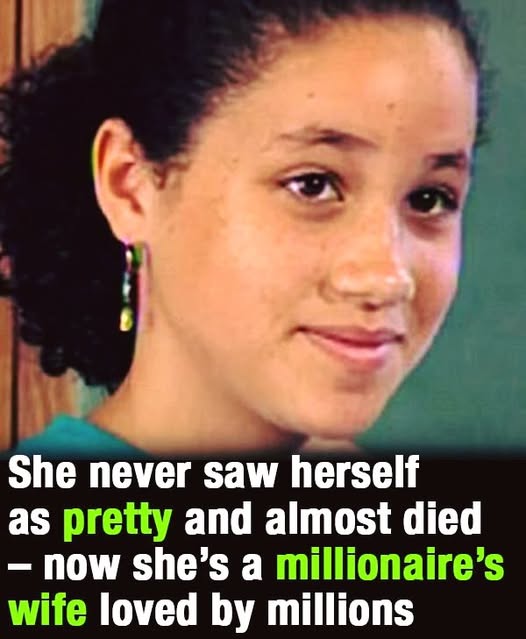
Long before the world called her the Duchess of Sussex, Meghan Markle was a little girl trying to understand why people kept asking where she belonged.
She grew up in Los Angeles between worlds that did not always know how to hold someone like her comfortably. Raised by a Black mother and a white father, Meghan learned early that identity could shape the way strangers looked at you before they ever learned your name. She has spoken about moments that stayed with her for years — people assuming her mother was the nanny instead of her parent, people trying to place her into neat categories she never fully fit.
Those experiences planted something lasting inside her:
awareness.
Awareness of race.
Of perception.
Of how quickly the world decides who someone is before hearing them speak.
But childhood was not glamorous in the way later headlines often implied. While many people would eventually associate Meghan with palaces and celebrity, her early life was far more ordinary and far more lonely at times. Her mother, Doria Ragland, balanced work as a makeup artist and social worker. Her father, Thomas Markle Sr., worked long hours in television production as a lighting director.
That meant Meghan often came home to empty rooms.
She later described herself as a “latchkey kid,” heating microwave meals after school, watching Jeopardy!, learning self-reliance earlier than many children do. Those quiet afternoons shaped her more deeply than royal life ever would. Independence became instinctive. So did ambition.
Because even as a child, Meghan seemed determined not merely to exist inside the world, but to speak back to it.
At eleven years old, she wrote letters protesting a sexist television commercial after becoming frustrated by the way women were portrayed. Most children notice unfairness briefly before moving on. Meghan pursued it until adults listened. That moment revealed something essential about her long before fame:
she believed her voice mattered.
Not loudly.
Not theatrically.
Simply enough to use it.
As she grew older, confidence and insecurity lived side by side inside her. Friends described her as intelligent, focused, and unusually mature. Yet Meghan herself later admitted she often felt awkward and uncertain about her appearance. Rather than seeing herself as “the pretty girl,” she leaned into academics, writing, and personal achievement.
Identity became something she built rather than inherited.
After her parents divorced, she moved primarily between different worlds and expectations while maintaining close relationships with both parents. The experience broadened her perspective but also deepened her understanding of instability. Public narratives would later reduce her upbringing to either privilege or struggle depending on who was telling the story. The reality was more human and complicated:
parents sacrificing for opportunity,
a daughter absorbing those sacrifices quietly,
a family imperfect but trying.
That complexity followed her into Hollywood.
People often assume proximity to the entertainment industry guarantees easy success. Meghan had spent time around television sets because of her father’s work, but familiarity with the business did not protect her from rejection. Like countless aspiring actors, she worked side jobs, babysat, auditioned repeatedly, and faced the exhausting uncertainty of trying to build a career in an industry obsessed with categorization.
And categorization became its own obstacle.
Casting directors frequently described her as “ethnically ambiguous,” a phrase that sounds almost clinical but carried real consequences. Meghan later explained she was often perceived as “not Black enough” for some roles and “not white enough” for others. Hollywood struggled to place her because she challenged simplified racial expectations the industry had long relied upon.
Still, she kept going.
Persistence eventually carried her to Suits, the legal drama that transformed her from struggling actress into recognizable public figure. As Rachel Zane, she projected intelligence, warmth, and quiet confidence in ways audiences responded to immediately. But even then, acting was only one piece of the life she was building.
Off-screen, Meghan cultivated interests that reached beyond celebrity:
humanitarian work,
women’s advocacy,
writing,
wellness,
travel,
social commentary.
Her lifestyle blog reflected someone trying to shape a fuller identity than “actress” alone. She appeared deeply interested in meaning, growth, and public service long before royalty entered the picture.
Then came 2016.
Meeting Prince Harry altered the scale of her life almost overnight.
At first, the relationship carried the excitement of modern fairy tale mythology:
an American actress,
a British prince,
a romance unfolding beneath global fascination.
But alongside the fascination came something harsher.
The scrutiny surrounding Meghan quickly intensified into obsession. Headlines dissected her race, family relationships, career history, personality, and motives with extraordinary aggression. Supporters saw possibility in her presence — a more modern and diverse face within the monarchy. Critics often viewed her through suspicion from the beginning.
And beneath all of it sat the same girl who once struggled quietly with belonging.
Only now the entire world was watching.
The 2018 royal wedding at St George’s Chapel felt historic partly because people projected so much symbolism onto it. Millions watched Meghan walk into royal history carrying not only a title, but decades of cultural expectation around race, class, tradition, and modern womanhood.
Yet marriage into royalty did not deliver the peace outsiders imagined.
Instead, public life intensified.
Every gesture became analysis.
Every outfit became commentary.
Every family tension became international news.
Inside that pressure, Meghan also became a mother.
Motherhood shifted the emotional center of her life in ways fame never could. Like many women, she experienced the collision between public expectation and private physical reality. She later revealed suffering postpartum preeclampsia after childbirth — a dangerous and potentially life-threatening complication many women endure quietly.
Her willingness to speak openly about it mattered because maternal suffering often remains hidden behind polished images of motherhood. Meghan consistently used visibility not simply to preserve image, but to expose vulnerability publicly:
miscarriage,
emotional pain,
mental health struggles,
the loneliness accompanying intense scrutiny.
When she wrote about losing a pregnancy, many readers connected not because she was royal, but because grief erased status temporarily. Miscarriage remains one of the most common yet least openly discussed forms of heartbreak women experience. By naming it publicly, she allowed others to feel less isolated inside similar loss.
That openness partly explains why Meghan continues to inspire such divided emotional reactions.
To supporters, she represents resilience:
a woman navigating race, identity, fame, motherhood, criticism, and institutional pressure while refusing to disappear quietly.
To critics, she symbolizes disruption — someone viewed as challenging royal expectations too publicly or too forcefully.
But regardless of perspective, her life story resists simplification.
She is neither pure fairy tale nor pure controversy.
She is a woman shaped by ambition, insecurity, perseverance, loneliness, visibility, and constant reinvention. A child who learned independence early. An actress who fought to belong in an industry uncomfortable with ambiguity. A public figure who entered one of the world’s oldest institutions carrying modern questions it was not fully prepared to answer.
Perhaps that is why her story continues resonating so deeply.
Because beneath the titles, headlines, and global debates remains something profoundly recognizable:
a person trying to define herself while the world keeps trying to define her first.
And maybe that has always been Meghan Markle’s real struggle —
not becoming famous,
not becoming royal,
but protecting her own sense of identity inside systems determined to turn her into symbol before allowing her to remain human.